


The Indian documentary may be traced back to the ‘factual films’ or Topicals as they were called, of Harishchandra Sakharam Bhatwadekar (Save Dada), who in 1899 shot a wrestling match and between two well-known wrestlers Pundalik Dada and Krishna Navi at Bombay’s Hanging Gardens. A short followed this on the antics of monkeys – the first Indian ‘documentaries.’ In 1901, Bhatwadekar made perhaps the first Indian newsreel of the public reception accorded to Ragunath P Paranjpye who had won a special distinction in Maths at Cambridge and in 1903 covered the great Durbar held in Delhi to celebrate the coronation of Edward VII.
Initially these ‘factual films’ were confined to the installation functions and weddings of Maharajas, Dusserah Festivals, day-to-day life of people in various parts of India, snippets from Parsi Theatre etc. Dadasaheb Phalke, though known as the father of the Indian fiction film, did try his hand at this genre of non-fiction filmmaking. He even made a documentary Chitrapat Kase Taya Kartat (How Films are made) in 1917, wherein he showed himself directing the cast, shooting and editing a film!
In 1920, a newsreel was made of the funeral procession and cremation of Lokmanya Tilak. Soon the general sessions of the Indian National Congress began to be covered.
Some of the earliest pioneers of the topicals were Narayan G Devare, the Patankar brothers, Hiralal Sen in Calcutta, shooting scenes on the streets, bathers in the river Hoogly, cockfights etc. Aurora Film Corporation, in fact, pioneered a regular newsreel named ‘Calcutta Film Gazette.’
Some of the early topicals were films on the sessions of the Indian National Congress where leaders like Gandhiji addressed the nation, a solar eclipse, the Viceroy’s Cup Race, inauguration of the Tata hydroelectric station etc. Initially the cameramen of those days would get what scenes they could, then the photographically bad shots or camera stops would be removed and the scenes be joined together. There was little concept of editing leave alone creative editing.
It was in the 1930s however about the same time that Robert Flaherty, John Grierson, Basil Wright were becoming aware off the theory and practice of documentary films that in India too, the seeds began to germinate. Dr PV Pathy (who had studied cinematography at ETPC, the predecessor of IDHEC, the premier school of cinematography in Paris and had made films on the city of Paris and in the Sahara), KS Hirelekar (who had studied the Culture Films in Germany) and DG Tendulkar (who had studied motion pictures in Moscow and Germany) brought the then latest concepts of the Documentary Film and laid the foundation of the Documentary Movement in India.
In the mid 1930s, the Quetta Earthquake took place. The Imperial Film Company of Bombay made a film synchronized to running commentary – an appeal for funds for those suffering as a result of the eathquake. Following this, Hirelekar began an Indian Newsreel unit. 16 short reels off the Congress Session at Faizpur were shot. In 1938, Wadia Movietone and Chicago Radio, in a combined effort, covered the Haripura Congress session where Netaji was the president.
With the breaking out of the Second World War in 1939, the documentary movement got a breakthrough. The British with their distinctive tradition in the Documentary movement decided to provide suitable infra structure for the Documentary in India to boost the War effort. The British introduced a Film Advisory Board (FAB) in 1940, which had JBH Wadia as its Chairman and Alexander Shaw as Chief Producer. Though making films mainly for the war effort, Shaw did produce films like Women of India and Industrial India, which were not directly connected with War Effort. The Tree of Wealth, made by A Bhaskar Rao was one off the earliest documentaries to win awards abroad.

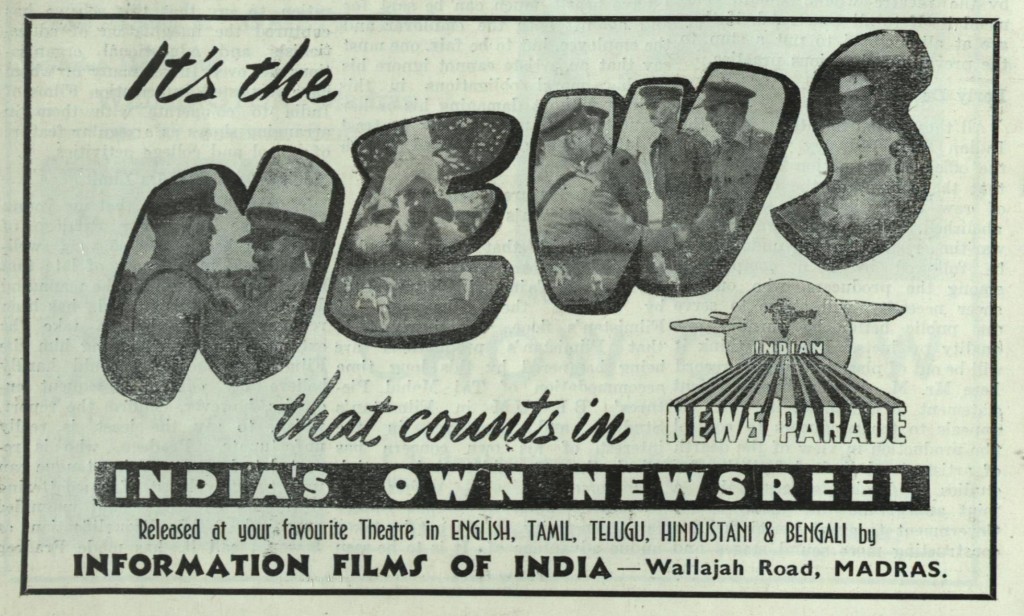
After Shaw left the FAB, Wadia persuaded V Shantaram to take over as Chief Producer. Shantaram did make a few films for the FAB but when Gandhiji gave the call of ” Do or Die” in 1942, he resigned and Ezra Mir took over. The Government realized the FAB wasn’t enough. To expand and consolidate Film Production and Distribution Units, on February1, 1943, The Information Films of India (IFI) and the Indian News Parade (INP) were formed. Keen that War Propaganda should reach maximum number of people, exhibitors were compelled to include 2000 feet of film approved by the Government. Thus the British Government laid the basis of compulsory distribution from which the Films Division was to benefit later on. Further, the Government charged a modest rental depending on the size and category of the cinema, thus exploring the revenue earning potential off these films. While Mir was in charge of IFI, Irishman William J Moylan an enterprising cinematographer-director was in charge of INP. Bewteen 1940 and 1946, the FAB and the IFI produced more than 170 films apart from the INP newsreels. Though mostly designed to promote the War effort, a few documentaries were also made on Arts and Crafts of India, Indian Classical dances and major Indian Industries by filmmakers like American born Ellis R Dungan. The IFI under Mir had a sizeable technical and administrative staff. Documentaries were got from other countries and dubbed in Indian languages.
But in 1946, the IFI came to an abrupt end. The Interim Government in the transfer of power to Indians, composed of the nationalist elements, cut down the grant to IFI and INP to a token rupee remembering their role in the War Propaganda films. A consequence of this was that for almost two years there was no official production of documentaries. Thus, at the time of India’s first Independence Day, there was no official film unit to cover this event! It was left mostly to newsreel cameramen of London, New York, Paris and other cities to converge to New Delhi to record the events. Pathy managed to coax Ambalal J Patel to provide a multi-purpose film unit with two cameras and sound equipment.Thus it was left to ‘Independents’ to film Nehru’s ‘tryst with destiny’ speech along with international newsreel cameramen.