


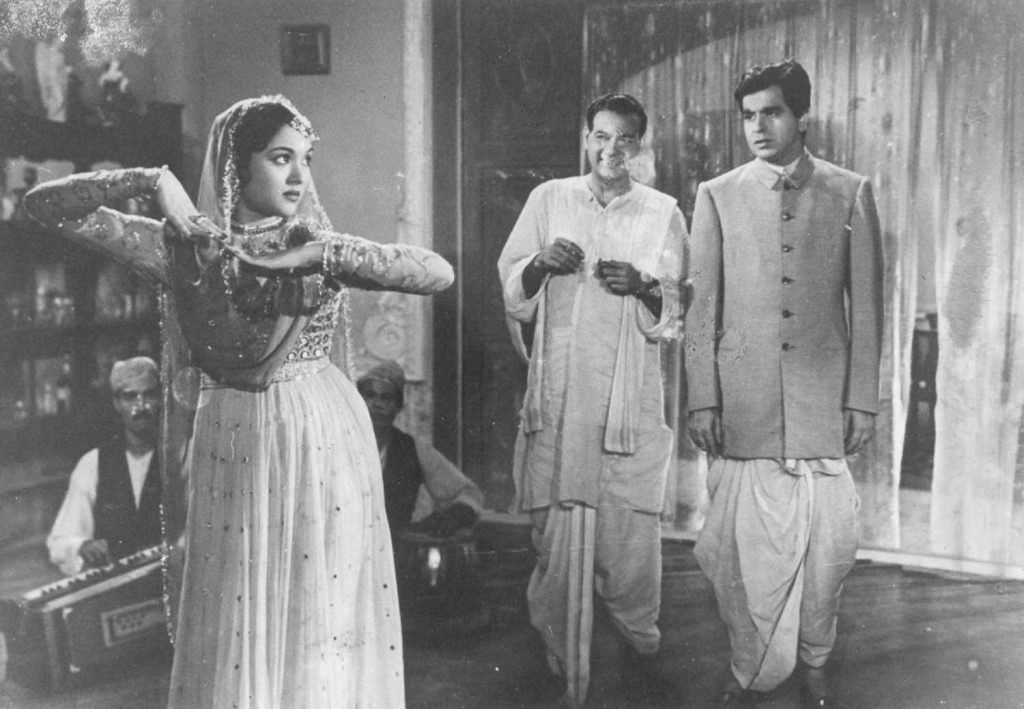
Set against the backdrop of rural Bengal during feudal times, Devdas is the story of a doomed love affair between Devdas (Dilip Kumar), son of the local zamindar, a high-caste Brahmin, and Parvati (Suchitra Sen), the daughter of a poor neighbour, also a Brahmin, but belonging to a slightly lower status in terms of caste, affluence and status. They grow up as childhood sweethearts. But when they decide to marry, Devdas’ father puts his foot down, packing his younger son off to Calcutta for higher studies. Parvati’s marriage is finalized with a wealthy zamindar, a widower with children older than his young second wife. Learning about Parvati’s marriage, Devdas rushes back to his village and tries to stop the marriage, in vain. Parvati is prepared to elope with him but Devdas refuses and Parvati leaves his room in the middle of the night, castigating him for his cowardice. In Calcutta, Chunilal (Motilal) introduces him to an attractive and strong-willed courtesan, Chandramukhi (Vyjayanthimala), and initiates Devdas into the darker corridors of the city. Devdas finds an easy escape in drink and though he insists that he hates Chandramukhi, he keeps coming back to her for moral support. Chandramukhi falls in love with him. He meets Parvati once more, when he returns to the village to perform the last rites of his father. Parvati pleads with him to give up drinking. He evades a direct reply and instead, promises to see her at least one last time before he dies. Chandramukhi gives up the life of a professional courtesan and concentrates on nursing the alcoholic Devdas back to health. He gives up drinking for some time and is advised to go on a holiday. He embarks on a train journey across the country, destination unknown. He stealthily runs away one night, leaving his faithful family retinue Dharamdas in the train when he chances upon a junction station that will take him to Manikpur where Parvati lives. He treks along in a bullock cart to see Parvati one last time…
Devdas (1935), produced by New Theatres and directed by PC Barua, revolutionalized the concept of cinema as entertainment into (a) cinema of social concern and (b) literature expressed through celluloid. Sarat Chandra Chatterjee, a then-frequent visitor at the New Theatres studio in south Calcutta, told Barua after seeing Devdas, “it appears that I was born to write Devdas because you were born to re-create it in cinema.” It was a rare tribute from a writer to the actor-director of a film based on his story. It remains also the most cinema-friendly novel having been made into film more than a dozen times in several Indian languages.
Barua’s Devdas was photographed by a new young cameraman at New Theatres. His name was Bimal Roy. In course of time, this cameraman became a producer and director in Bombay and directed the same film, this time in Hindi, under his production banner, Bimal Roy Productions, 20 years later. Bimal Roy’s Devdas stands independent of its inspiration and carries the typical signature of its new maker, producer and director Bimal Roy. This individuality lies in the approach, style and interpretation. The difference lies in the camerawork, because Bimal Roy paid very close attention to the visual details of his film, having evolved from cameraman to director. Without the use of dialogue, he could build up a situation by manipulating the visual power of cinema. Bimal Roy’s signature lies also in the scripting of the music, the songs and the lyrics, created to jell with the period, the characters and the place setting of the narrative.
The film’s characters are not heroes and villains but ordinary people conditioned by a rigid and crumbling social system. Even the lead character, Devdas, has no heroic dimensions to his character. What one sees are his weaknesses, his narcissism, his humanity as he is torn by driving passion and inner-conflict. Bimal Roy’s Devdas reflects an almost identical approach. Seen in retrospect, the two women in his life, Parvati and Chandramukhi, are stronger than he is, as independent women with minds of their own with Devdas being an unwitting catalyst in Chandramukhi’s life. Bimal Roy creates a build-up of the love between Devdas and Parvati by tracing their childhood through Devdas’s pranks and Parvati backing him up all the time. Some of their ‘signals’ are echoed when they grow up and Devdas throws a stone on the roof of Parvati’s house to call her, like he did when they were kids. Roy dots these with songs and two baul numbers, namely, Geeta Dutt-Manna Dey’s Sajan ki Ho Gayi Gori and the eternally beautiful Aan Milo Aan Milo Shyam Saanwre, drawing on the Radha-Krishna allegory to symbolize the tragedy of their love. The closure of the film is a marked departure from the original novel and follow’s Barua’s version. When Parvati hears that her Devdas is dying under a tree outside her house, she runs out to see him. But as she rushes out, the doors begin to close on her. This door is a metaphor for the social taboo against a married woman rushing out to see her former lover, crossing the threshold of her marital home. It was unthinkable in those days. Another beautiful touch where Roy takes liberties with the original is when Devdas, after his beloved Parvati has been married to another, wanders aimlessly, drinking and shooting down birds at random. Manorama, a friend of Parvati who spots him from a distance while carrying a pot of water back home, is scared to cross his path. But Devdas merely comes close to the girl and asks her how she is. This building a scene to an unpredictable anti-climax in a film spilling over with dramatic twists and turns and human tragedy carries the distinct stamp of Bimal Roy as a filmmaker in his own right.
When Devdas was being made, Dilip Kumar was already established as one of the top triumvirate that defined Hindi cinema – Raj Kapoor, Dilip Kumar and Dev Anand. Devdas shows Dilip Kumar at the peak of his career where in the title role of the tragic hero, he invests the literary character with his personal chemistry of an actor par excellence. Vyjayanthimala’s Chandramukhi is embellished with her graceful dance style that evolves with the evolution in her character within the film from a popular dancing woman to a woman, who, in love with Devdas, has unconsciously mutated to reflect the mainstream woman. For Vyjayanthimala, the character marked a turning point from glamour to pure histrionics, offering her scope to explore her potential as a dramatic actress without taking away from her, the most outstanding gift she brought to cinema – her dance. Suchitra Sen as the grown-up Parvati is ethereal, the pride showing up in that scene on the banks of the pond where Devdas uses his fishing line to mar her beauty. She carries the scar as a sad reminder of their doomed love story. She is courageous enough to come to Devdas asking him to take her away. Yet, when she gets married, like the ideal Indian housewife and mother, she moulds herself into the vessel she is poured into. It is a fine debut for Suchitra in Hindi cinema. Motilal is the best Chunilal among the many versions of Devdas that have been made. He portrays to perfection the fine blend of the elite and the mundane, the lover of a joyful life who has enough depth to understand the tragedy of his friend. Baby Naaz as the child Parvati is a natural and delight to watch. Ram Kumar is no patch on her.
Sudhendu Roy’s art direction is so credible and earthy that it is almost impossible to believe that the entire village was constructed within Mohan Studios. Kamal Bose’s evocative and at times poetic cinematography keeps to the pace of the film while Hrishikesh Mukherjee’s editing adds its own slow and sad rhythm to this immortal love that ends in tragedy. The film effectively uses the jump cut several times towards the end when Devdas is travelling by train. When Devdas vomits blood during his travels, the camera cuts in to Parvati falling in a faint, far away in her village home. In a night scene on the train, as soon as Devdas calls out to Paro, the scene cuts once again to show Parvati screaming out in her sleep, in the middle of a nightmare. Her husband tells her she is mistaken. These scenes spell out the psychological stress his characters were reeling under, as also the telepathic bonding the lovers shared, without reducing these to melodrama or using sentimental dialogue.
The music, composed by SD Burman on lyrics penned by Sahir Ludhianvi is another hallmark of this beautiful film with the standout number being the Talat Mahmood solo Mitwa. Background music is used very sparingly and effectively. And when used, it is utilised beautifully such as in the shot showing the transition of Parvati from a little girl to a grownup woman when she goes to fetch water in the local pond, a line of basant bahar plays in the background, indicating the coming of spring as Devdas is coming back to the village. Once more, when Chandramukhi picks Devdas off the streets and brings him to her abode, off the frame, she belts out a line of song in bhairavi, a morning raga, and a metaphor on the breaking of a new dawn in her life. The music also ashows the change in Chandramukhi as is evident from Ab Aage Teri Marzi through O Jaanewale Ruk Jaa Thodi Dum to Jise tu Kabool Kar Le sung by Lata Mangeshkar, a timeless number, and Mubarak Begum’s Woh Na Aayenge Palatke, Unhen Lakh Hum Bulayen. At one point, Devdas laments, “Parvati and you are so different from each other and yet so very similar.” The differences between the two have blurred beyond recognition.
The social relevance of Bimal Roy’s Devdas lies in that it was the first film within mainstream Hindi cinema in Bombay, to place on celluloid, the social ramifications of a man of high birth who moves away from his feudal, upper-class roots in rural Bengal to the colonial city of Calcutta during pre-World War II years. It tried to explore the inner pain of this man, torn between the pull he feels towards his village roots and his wish to run away to the city to escape from the tragic reality of a lost love. His willful manner of moving towards self-destruction could be read as his casual indifference to the village that he once belonged to, a village he now responds to with mixed feelings. Before his death, he tries, in vain, to run away from an anonymous death in the unfeeling city, by coming back to the village, in one last desperate attempt to renew lost ties. The harsh, heartless reality of the city has changed his perspective towards the village. He rejects the tempting illusions and fantasies the city once held for him. The city loses Devdas but the village too, refuses to accept him even in his ignominious, humiliating and tragic death. Only two women – Parvati and Chandramukhi, who operate like invisible, unwritten ‘guardians of conscience’ in the wreckage his life is reduced to, are left to grieve over his death.
Hindi, Drama, Black & White
So beautifully written…a true cine lover will b unable to stop himself from watching bimal roy’s devdas….also these type of articles keeps him alive ever. This not only teaches the artistic student bt also motivates them to do make better cinema..thanqiuu…