


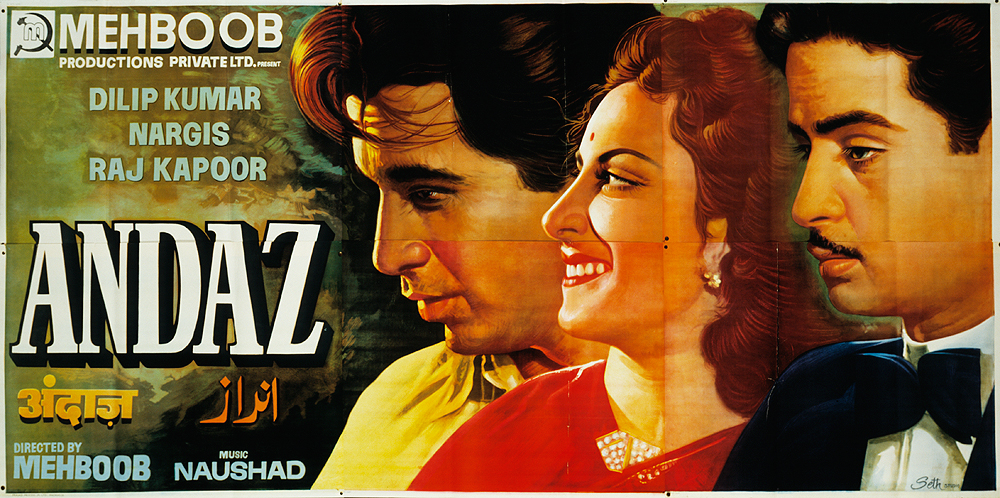
Neeta (Nargis) is saved by Dilip (Dilip Kumar) when her horse veers off control. A friendship develops between the two with Dilip falling in love with Neeta and as it appears, her with him. Her father warns her against this friendship with Dilip and her ‘modern’ ways but Neeta brushes his warning aside. In fact, she turns to Dilip’s shoulder when her father passes away and even makes him a partner in the family business that she inherits. However, it turns out that Neeta is in love with and engaged to Rajan (Raj Kapoor) and marries him once he returns from abroad. When Dilip declares his love for her on her wedding night, she wishes he hadn’t told her so and ask him to take his words back. This conversation is heard by Rajan , who begins to suspect Neeta’s infidelity keeping her away from their little daughter even as Dilip starts getting more and more frustrated under the pressure of his thwarted desires. Going out of his mind, Dilip turns on Neeta telling her she really loves him and not Rajan. Neeta shoots down the advancing Dilip and is tried for his murder. Rajan comes to know that Neeta has always loved him and no one else but it is too late as he himself had testified against her citing her behaviour with Dilip. Neeta is sentenced to life imprisonment and when Rajan comes to meet her in jail, she implores him to bring their daughter up properly and not let her make the same ‘modern’ mistakes she did.
Andaz is till date regarded as the mother of all triangles of Hindi Cinema. Love triangles were made frequently even before Andaz but such is it’s impact on Indian Cinema, that whenever the genre of love triangles in Indian Cinema is discussed, the first film that comes to mind is Andaz! The film had everything going for it right from its sensational star cast of Nargis, Dilip Kumar and Raj Kapoor. Though today Andaz is talked about its unique casting coup of bringing together Dilip Kumar and Raj Kapoor, it must be mentioned that at the time of Andaz’s making, both were just beginning to find their foothold in the Hindi film industry and hence though their coming together is today regarded as a coup, it was not really when the film was made.
In Andaz, Mehboob targets the youth of the 1940s, whom he felt were wrongly aping western culture, behaviour and fashion and addresses to them the greatness of Indian traditions. This aspect of the film creates its central conflict – one between a newly Independent India turning to capitalist modernization while, at the same time, retaining her feudal family and moral values. Above all, what really makes this film (regarded as independent India’s first ‘modern film’ looking at its affluent urban class) work is its high production value, a technical gloss hitherto unseen in Hindi cinema (superbly photographed by Faredoon Irani) and of course, its engrossing dramatic content along with highly-charged lead performances that elevate the film several, several notches above the commonplace.
What gives Andaz it’s cult status and timelessness is that the film remains startlingly modern even in today’s times even though it propagates traditionalism. Even as Mehboob, on the surface, propagates the upholding of traditional Indian values and questions whether friendship between members of the opposite sex can ever be platonic, somewher,e the film acquires an additional depth and layer through the playing of the centre character by Nargis, maybe accidentally so. Though Nargis claims that she was just friends with Dilip Kumar and clearly loves Raj Kapoor whom she has married, her interpretation of the role suggests that she has, in fact, responded to Dilip Kumar’s love for her in Raj’s absence, even if subconsciously. One cannot blame Dilip Kumar for thinking she returns his affections. Even the audience feels that she is indeed in love with him. Mehboob cleverly develops the meetings and ‘romance’ between Dilip Kumar and Nargis. Remember, it was 1949 and audiences would not have accepted a woman’s friendship with a man when she is already engaged to another. So Mehboob brings Raj Kapoor in as a surprise element. Just when you think the love story is developing between Dilip Kumar and Nargis, she tells him of Raj’s arrival and immeditely picks up the threads of her love story with Raj Kapoor. If one knew that Nargis was bethrothed to Raj Kapoor and she was this open with Dilip Kumar, she would have been labelled a slut but bringing him in later not only brings a twist in the tale but heightens the drama of the film.
To further push this point home, when Dilip Kumar declares his love for Nargis on her wedding day, her reaction is not one of shock that how could he think their friendship was love but one that confirms her worst fears. Consequently, what comes out is a highly charged and volatile love triangle rising to great levels of Greek tragedy. Sadly though , the ending of the film is highly disappointing as Nargis appeals to Raj Kapoor to take care that her daughter toes the line and does what society expects her to do, thereby going pretty much backwards rather than forward. This, I think was Mehboob’s actually intended if regressive message in the film. This is why I suspect the complexity has come through unintentionally through Nargis’ layered act, which somewhere went beyond the director’s control.
Andaz took Nargis right to the top and established her without doubt as India’s finest dramatic actress of her time. It is also one in a series of films where she played a heroine caught in the dilemma of the heart leading to tragic results, the kind of roles played by silent film star Patience Cooper in the 1920s. Dilip Kumar, too, consolidated on his image of paying the tragic lover as he handles the author-backed role of the doomed lover with ease. Raj Kapoor, in the more difficult role of the husband suspecting his wife’s infidelity, more than manages to match strides with Dilip Kumar while showcasing the comic side of his personality as well. Developing an individualistic set of mannerisms overdone for effect, his performance is a total contrast to Dilip Kumar’s subtle underplaying. The supporting cast led by Cuckoo, Murad and VH Desai is adequate although the comedy sequences with Desai seem to go on and on and really add nothing to the film.
The film is a musical triumph for Naushad. Each and every song in the film is wonderfully composed and was a raging hit – Tu Kahe Agar, Jhoom Jhoom Ke Nacho Aaj, Toote Na Dil Toote Na, Hum Aaj Kahin Dil Kho Baithe, Uthaye Ja Unke Situm, Tod Diya Dil Mera are among the finest songs that Naushad has done. The last two sung by Lata Mangeshkar represent her early singing work in the year when she finally broke through to become India’s leading playback artist and it is interesting to see her initial singing style highly reminiscent of the great singing star, Noor Jehan. Interestingly, Naushad uses Mohammed Rafi to sing for Raj Kapoor and Mukesh for Dilip Kumar. But again at this state of their careers, the Raj-Mukesh and Dilip-Rafi pairings were yet to be solidly established and, in fact, Mukesh had already scored heavily under Naushad singing for Dilip Kumar in Mela (1948), just the previous year.
Thus, rather then a film of simply pitting ‘Western Modernity’ v/s ‘Indian Tradition’ Andaz emerges as a layered, timeless classic in spite of the regressive ending. One might even go as far to say that it is perhaps Mehboob’s finest film, Mother India (1957) notwithstanding.
Hindi, Drama, Black & White
nice review. i feel desai’s comedy was just about right
Unlike many others, I never developed an appreciation for Dilip Kumar; thought he came across as a legend in his own mind. Even his acclaimed performance in Devdas pales in comparison to Nageswara Rao’s in the Telugu film Devadasu, produced a few years before Bimal Roy’s hindi version. And his penchant for going after married women – declaring his love for Nargis on her wedding day in the movie; just as his affair with a married woman in his real life, and his eventual marriage with Saira Banu, at an age where she could have been his daughter.
He is a legend in his own mind.