


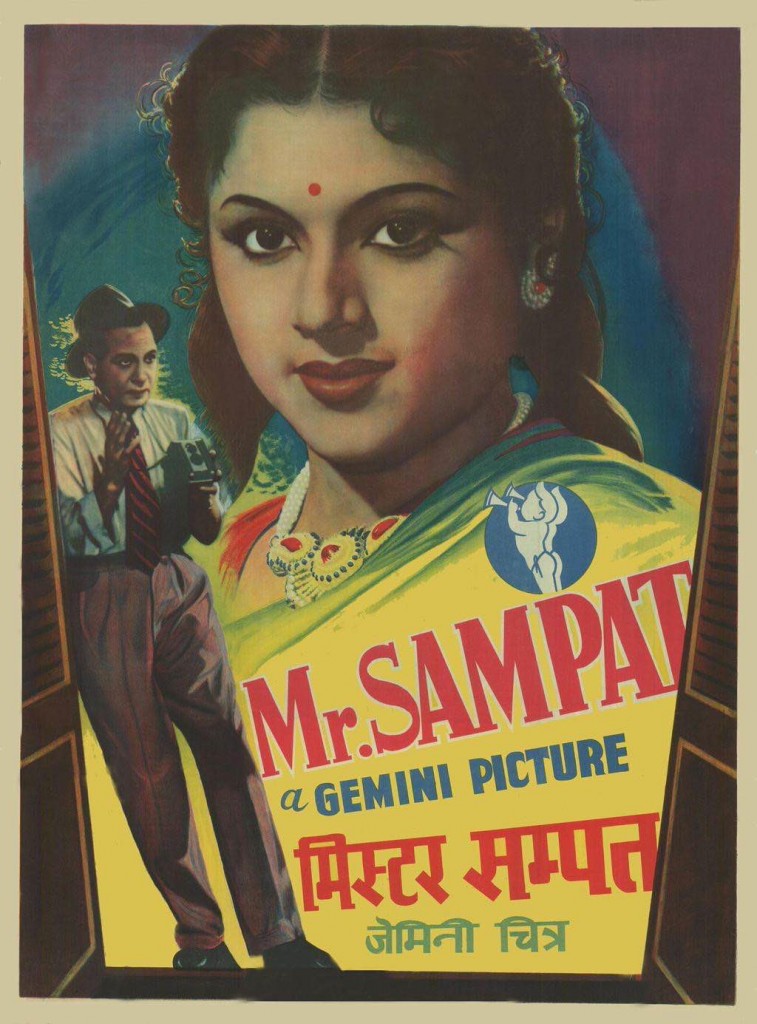
Fast talking conman, Mr. Sampat, (Motilal), lives by his wits and survives by conning people. He connives and concocts an elaborate scheme wherein he involves theatre diva, Malini (Padmini), and Seth Makhanlal Gheewala (Kanhaiyalal). He uses the former, helps the latter to win the local municipal elections and then gets them involved in starting a bank – Friends Bank by offering customers higher interest. Naturally deposits are high. He even persuades Malini to start her own theatre company leaving the Kala Mandir Company where she gained her reputation. But even as Sampat has a good life, a local maharaja who had huge deposits with the bank due to Malini withdraws his funds when she snubs his advances. Soon, all his schemes fail and both the Seth and Malini lose huge amounts of money. Seeing he has nothing more to gain anymore, Sampat leaves them to deal with their problems themselves and moves on…
1948 saw the Southern studios break into the Hindi Film Industry in a big way with the mega success of Chandralekha. The film, produced by the Gemini Studios and directed by the legendary SS Vasan, is remembered even today for its spectacular drum dance, still unmatched till today. Following the success of Chandralekha, Vasan then directed Nishan (1949) and Sansar (1951) before coming out with perhaps his best Hindi film, Mr. Sampat (1952).
Mr. Sampat is based on RK Narayan’s book Mr. Sampat: The Printer of Malgudi. However, Vasan in fact took enough liberties with the original work, turning it into a broad burlesque film and using it successfully to lampoon politicians, ex-princes, journalists, filmstars, religious zealots and bogus philanthropists. To his credit, Vasan handles the satirical elements of the film extremely well making the film delightfully irrelevant and thoroughly amusing. Among several memorable scenes in this film is one, for example, where at a charity organization, a politician and a Marxist leader give speeches to uplift the poor and then totally ignore a man lying on the road!
In that sense Mr. Sampat is a remarkable film working on many levels as the film challenges the notions of the commercialization of art and tries to show that serious work can be successful too. This is something true of all art forms be it art, music, theatre or even cinema. This is clearly shown that as Malini is a respected theatre artiste with the Kala Mandir, the plays she performs in there are plays of social concerns looking at problems facing a young Independent India in its first few years after Independence in the days of controls and permits. However, once Malini starts her own theatre company under Sampat’s devious advice it is important to note that all the plays staged here are cheap mythologicals with little or no depth. Going by the logic that ‘this is what people want’, this represents Malini’s fall as an intellectual and thinking artiste.
Vasan himself believed that films were meant to entertain and were meant to be catered to the ordinary man. Colossal production values, huge sets, mammoth dances, thousands of extras were his hallmark. Thus his films were regarded as mere variety entertainment instead of true cinema. This is true of his swashbuckling entertainers such as Chandralekha or Insaniyat but not entirely true of Mr. Sampat. Maybe, this is because here Vasan had adapted a famous novel and being somewhat a novelist himself, he realized the importance of staying faithful to the spirit of the book. Incidentally, Vasan’s own novel, Sati Leelavathi, was also made into a film and which, incidentally, was directed by American filmmaker, Ellis R Dungan, and was also MG Ramachandran’s debut film.
Coming to the performances, Motilal is the life and soul of the film as the fast talking confidence trickster, perhaps his best known screen role. He was a debonair and stylish man and was the one actor who, along with Ashok Kumar, was largely responsible for a much more naturalistic style of acting in Hindi films. He is spot on in his sense of comic timing. Special mention must be made of the scenes where he cons the same conductor in the beginning and at the end of the film as he is ticketless on each occasion. Padmini, in her first major Hindi film role, plays Malini the theatre actress who is lured into his money making schemes by Sampat and it is a fine performance. As with every South Indian Actress who entered Hindi films, their training in dance gave them a distinct advantage over their North Indian contemporaries. With Padmini, too, being a brilliant dancer, many of the stage performances in the film make splendid use of her tremendous ability as a dancer. Of the supporting cast, Kanhaiyalal stands out as the ghee merchant tricked into losing all his money following Sampat’s various schemes. Agha is his usual competent self in the role of the tea owner whose main desire is to give Malini a cup of tea to drink from his hotel.
What is remarkable in Mr. Sampat is the way music has been used in the film. The songs have been used exclusively only for the theatre sequences and that too in a collage form rather than songs as themselves. The theatre sequences are a mixture of the song and dance and dialogue pieces and are exactly like variety entertainment sequences. Though the stage sequences are admittedly a trifle long, it is to the film’s great credit that it tries to weave the music into the story and stay faithful to it rather than try to capatilize on the great craze that Hindi Film music had become by then and just have random catchy songs or item pieces. What’s more, the songs like Achhe Din Aa Rahen Hain (ahead of its times!) and Din Control Ke Aaye make telling points through their lyrics.
Unfortunately however, satirical comedies are rare in Indian cinema as they are thought to lack repeat value even though films like New Delhi (1956), Parakh (1960) and much more recently Jaane Bhi Do Yaaro (1983) prove otherwise. Thus, our producers continue to favour other genres like romances and melodrama rather than the satire, which is the one form which proves that you can be entertaining and thought provoking at the same time. Ironically it is exactly the form the Kala Mandir plays use in the film. It is a fine example of satire-within-satire and works extremely well in the film. Of course, there could be debates on where and how the film has deviated from the book and again raise questions on the delicate relationship between literature and cinema but it has to be said that Mr. Sampat is as fine a film on its own level.
Hindi, Comedy, Drama, Black & White