


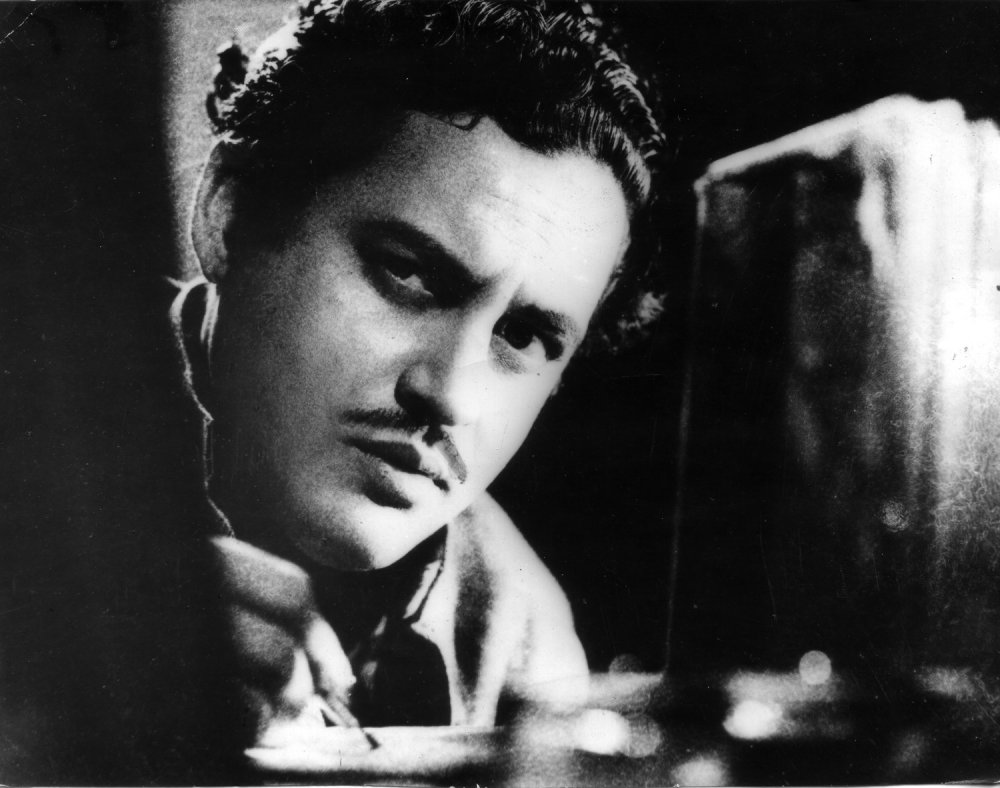
Vijay (Guru Dutt) is an unsuccessful poet whose works are not taken seriously by publishers or his brothers, who sell his poems as waste paper. Unable to bear their taunting at him being a good for nothing, he stays away from home often out on the streets. He encounters a prostitute on the streets, Gulabo (Waheeda Rehman), enamoured of his poetry and who falls in love with him. He also encounters his ex-girlfriend, Meena (Mala Sinha), from college and finds out that she is married to a big publisher, Mr Ghosh (Rehman), for financial security and who hires him as a servant to find out more about him and Meena. A dead beggar to whom Vijay gave his coat and whom he tries to save unsuccessfully from the path of a running train is mistaken for Vijay. Gulabo goes to Ghosh and gets his poems published. Ghosh does so feeling he can exploit the poems and make a killing. But Vijay is alive and in hospital after the train mishap. Ghosh and Shyam, Vijay’s close friend, refuse to recognise him and he is committed to a mental asylum since he insisits he is Vijay and is thought to be mad. Vijay’s brothers too are bought off by Ghosh not to recognize him and a memorial is held for the dead poet. Vijay with the help of his friend, Abdul Sattar (Johhnny Walker), escapes from the mental asylum and reaches the memorial service where he denounces this corrupt and materialistic world. Seeing that Vijay alive, his friend and brothers take side with a rival publisher for more money and declare this is indeed Vijay. At a function to honour him, Vijay sick of all the hypocrisy in the world around him declares he is not Vijay and leaves with Gulabo to start a new life.
Pyaasa, released in 1957 during the golden age of Hindi cinema (the 1950s and ’60s), is Guru Dutt’s real masterpiece and one of the finest films ever made in India. It tells of the thirst of its protagonist, a poet, for love, for recognition and for spiritual fulfilment. The film is a strong parallel between the hero, the outsider trying to make a place for himself in the materialistic and selfish society he inhabits and Guru Dutt, the director, attempting to leave his independent stamp in a world of formulaic mainstream cinema.It is in Pyaasa where we really see Guru Dutt transcend way above the ordinary and succeed in totality.
Pyaasa was an idea Guru Dutt had for quite some time. He had written the first draft of the script himself around 1947 and had called it Kashmakash. However once he became a director, he initially made relatively more formulaic films like Baazi (1951) and Aar Paar (1954) in a bid to establish himself. But even within these films, there was the attempt to go beyond, to break barriers. All of this culminated in Pyaasa. The film, while having similarities to the Devdas story, also seems inspired by the famous quote, “Seven cities warred for Homer being dead, Who living had no roof to shroud his head”, in that Vijay struggles to get his poems published only to have them sell like hotcakes once he is thought to be no more. He also sees how everyone wants to exploit his ‘death’ for their own selfish needs.
Pyaasa sees Guru Dutt in fine control of his directorial craft. The exposition is beautifully set up telling us all we need to know about Vijay and flows seamlessly from one scene to the next. It begins by establishing Vijay’s sensitivity and poetic nature as he sees a bee being crushed under a human shoe (a destruction of Vijay’s dreams and art?). We then move on to to his argument with the publisher who wants him to write on love and nature, whereas Vijay prefers to write on the real problems of life. It is obvious his poems don’t ‘sell’. The film establishes him as an outcast as he no longer lives with his family as his older brothers treat him and his unemployment as a burden and there is nothing his poor mother can do about it. He finds out his brothers have sold his file of poems to a ‘raddiwala’ who tells him it was bought by a woman. Taking shelter with his friend Shyam, he is kicked out when Shyam’s woman companion comes over. And once out all alone in the city, he hears his poem being recited by a woman, a prostitute, who tries to entice him with his very poem, only to dive him away when she sees he is broke. And then he sees his ex-love we have a flashback sequence which reveals her to be his college sweetheart… Coincidences yes, but every scene has a definite role to play as it lays out the various inter-character dynamics for the story to follow.
Pyaasa establishes Guru Dutt as among the finest auteurs of Indian cinema Many individual shots and scenes in the film become impressionistic images telling of Guru Dutt’s lyricism. An example which immediately comes to mind is the song Aaj Sajan Mohe Ang Lagalo. It is a kirtan – a Bengali devotional song telling of longing and desire. Though we see Baul singers perform the song, it, in fact, voices the prostitute’s passion for the poet. She follows the poet up the stairs to the terrace where he stands his back to her. She moves towards him but cannot bring herself to touch him and she runs away. The earthly love she feels is uplifted and given a spiritual dimension through the words. And this is further reinforced by the amazing rendering of the song by Geeta Dutt. In the last scene of the film, an instrumental version of the song is played as the prostitute overcome with joy at seeing the poet at her doorway runs down the steps of her house into his arms. They are one. What is most interesting to note in their relationship is that the prostitute shares with the poet a greater attraction for spiritual fulfilment rather than materialistic and physical fulfilment.
Guru Dutt also invokes Christ and his crucifixion at various points in the film. We see this as Vijay stands in the pose of Christ on the cross against the bookcase in Mr Ghosh’s house in the Jane Woh Kaise Log The Jinke song and again in the Yeh Duniya Agar Mil Bhi Jaye Toh Kya Hai song. Also when she is told of his death on the breakfast table (a tribute to Citizen Kane and Orson Welles?), she is reading a magazine which has an image of the crucifixion on it cover. The fact that Vijay is not dead and lands up at his own memorial service, parallels the resurrection of Christ.
In many of Guru Dutt’s films we see him caught between two women – Aar Paar (1954), Kaagaz ke Phool (1959) and Sahib Bibi Aur Ghulam (1962). In Pyaasa too, apart from Gulabo, there is Meena, who leaves him and marries for security. Her priority is clearly materialistic fulfilment. Only to have her feelings for Vijay resurface when she meets him again. Though having negative shades to it, this is actually the more difficult and challenging female role in the film as against the standard prostitute-with-a heart-of-gold role. It has its layers and shades of grey making Meena a more rounded characters than Gulabo. It is interesting that Meena continues to believe in the power of money as she first tries to haggle with Gulabo, trying to buy off Vijay’s poems, when the former brings Vijay’s poems to Ghosh for publishing. She is also the one with whom the last but one scene in the library plays out as she urges Vijay not to reject the money and fame that he has been searching for all his life; especially now that it is finally in his grasp. But Vijay can take the hypocrisy and selfishness of the world around him no more and takes a utopian way out – to go somewhere far away from all the world’s evils with his true soulmate, Gulabo.
Pyaasa counts as one of actress Mala Sinha’s better and more subtle performances, a far cry from her rather mechanical and melodramatic performances. Talking of the acting, Waheeda Rehman is outstanding in the role of the prostitute and Guru Dutt himself is fine in the role of the poet. Perhaps the parallels between him and the character help him in coming out with his best ever screen performance. Though Dilip Kumar was the original choice for Vijay’s role, one has to admit Guru Dutt made the character his own. Rehman, Johnny Walker, Kum Kum, Leela Mishra and Mehmood all provide more than adequate support but special mention must be made of Guru Dutt’s assistant director, Shyam Kapoor, who effectively plays his slimy and materialistic friend, Shyam.
In lyricist Sahir Ludhianvi, Guru Dutt found the soul of Pyaasa. Sahir’s words seem to articulate Guru Dutt’s own view of the world and experience of tragedy. Pyaasa sees some of Sahir’s best work, perhaps greatest ever work as a lyricist. Here was a man who wore his emotions and politics on his sleeve. Yeh Mehlon Yeh Thakhton, Jaane Woh Kaise Log The Jinke and Jinhe Naaz Hai Hind Par Woh Kahaan Hai are some of the finest songs written for Hindi cinema – the last looking at the disillusionment against Nehruvian socialism that had set in a decade after the giddy euphoria of Indian Independence. It was taken from his poem Chakle (Brothels), a fine example of political comment combined with humanitarian compassion for the fallen woman.
The music by SD Burman is extraordinary allowing Sahir’s poetry to flower. Sadly, it was their last collaboration and the two would never work together again. Each of the songs is masterfully composed and the film is a triumph for all three playback singers. Jinhe Naaz Hai Hind and Yeh Duniya Agar Mil Bhi Jaaye prove what a fine and versatile singer Mohammed Rafi was. He renders them as effectively as the lighter Sar Jo Tera Chakraye. Geeta Dutt is absolutely magical in Aaj Sajan Mohe Ang Laga Lo and Jaane Kya Tune Kahi, naming both in her list of her ten favourite songs. Hemant Kumar has never sounded better than in Jaane Woh Kaise Log The Jinke. Sadly, a beautiful Geeta Dutt solo, Rut Phire Par Din Hamare was removed from the film about a week after it had released. Guru Dutt himself is in fine form picturizing the songs brilliantly. The background music helps to create the necessary atmosphere for a number of individual scenes. The Mala Sinha character has her own signature tune or motif – a simple yet haunting melody played on the harmonica by RD Burman. Whenever the poet sees her, the tune is played – representing for him the love he has lost.
Interestingly, Pyaasa has that rare element in a Guru Dutt film. A song treated like a fantasy. An idyllic daydream of the hero. The song Hum Aapki Aankhon Mein is picturised amongst clouds as the heroine descends from the moon. It is said that Guru Dutt picturised it in such a manner just to get back at the distributors who felt that an ‘item’ was needed. So he provided them with one! Another weak moment in the film is when Johnny Walker sings Sar Jo Tera Chakraye at the mental asylum to distract the guards so Guru Dutt can escape. It is too ‘filmi’ a moment that sticks out like a sore thumb in this otherwise flalwless film.
Special mention has to made of VK Murthy’s evocative cinematography. It is easily amongst the best black and white camerawork done in the history of Hindi cinema with extremely brilliant use of light and shade. The film makes use of dynamic tracking shots and effective close-ups of characters in their more emotional/introspective moments. Biren Naug’s art direction has to be lauded, in particular, for the creation of the red light area of Calcutta. In fact, Guru Dutt did try to film on location in Calcutta but could not due to crowd troubles and so filmed it in Mumbai.
In a film, that is almost perfect, the one moment that appears perhaps false and obviously ‘filmi’ is how Johnny Walker helps Guru Dutt escape from the mental asylum. It looks as if the makers were stumped to solve this issue in an innovative manner and succumbed to the easiest and most convenient solution. But otherwise, Pyaasa continues to be as relevant a film as ever even today, A true sign of a classic, it has, in fact, gotten better with age, its reputation growing with each screening!
Hindi, Drama, Black & White