


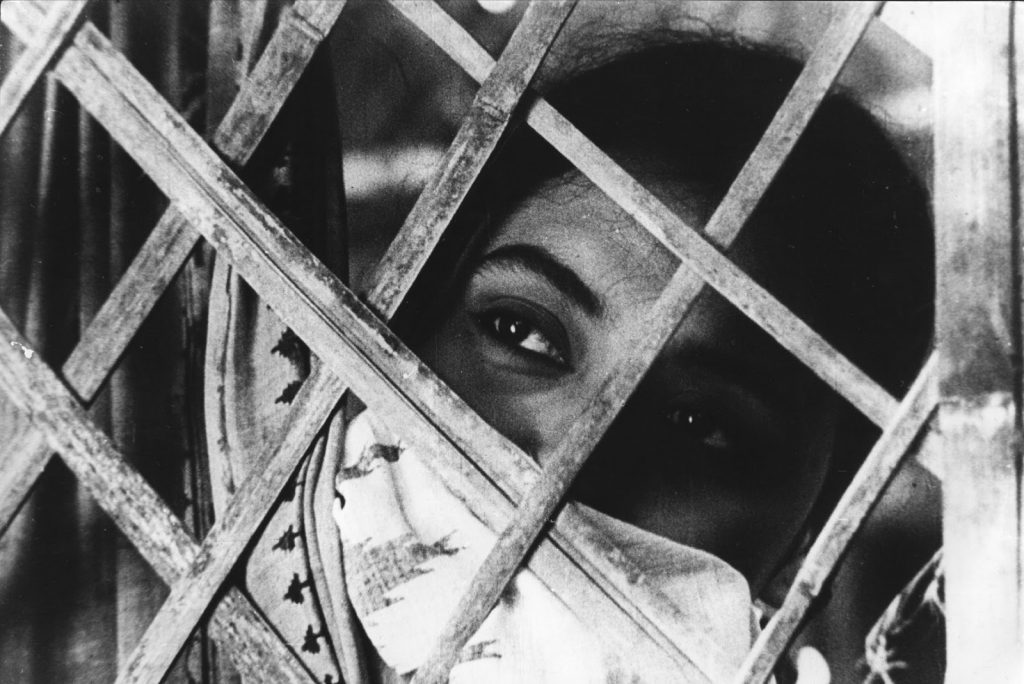
In the late 1950s, a refugee family from East Bengal, victims of the Partition, struggle for survival on the outskirts of Calcutta. Nita, the eldest daughter of the family (Supriya Devi), works as a private tutor while pursuing her post-graduate studies. Shankar, the eccentric and irresponsible elder son, is concerned only with his music and dreams of becoming a well-known singer one day The two younger children, Gita and Montu, are still students while the old father teaches in a small school. In Nita’s drab life, there is only one thing to look forward to: the return of Sanat, a young scientist she hopes to marry one day. However, he comes back from higher studies and remains unemployed, struggling to continue his research. Nita encourages him and even helps him with money from her meager earnings. But unknown to her, Sanat finds himself drawn Gita, who he had known as a child and who has now blossomed into an attractive young woman.The increasing needs of her family lead Nita to give up her studies and take up a full-time job in an office. Soon, her father is too ill to work, and Montu drops out of college to work in a factory against everyone’s wishes. Meanwhile, without telling Nita, Sanat prepares to marry Gita. Emotionally shattered when she finds out, Nita attempts gamely to carry on with life but then Montu has an accident and has to be hospitalized. Nita seeks and accepts help from Sanat, but spurns his attempts to salvage their old friendship. With Montu now unable to earn, the entire burden to look after the family falls on Nita, who under all the stress, takes ill with tuberculosis…
Meghe Dhaka Tara is rated as Ritwik Ghatak’s greatest film and the first in a trilogy that examines the socio-economic implications of the partition of India, the others being Komal Gandhar (1961) and Subarnarekha (1965). In visiting the division of the country, a subject very close to his heart, Ghatak had a perceptive vision that was unique. It assimilated the searing spectacle of the partition of Bengal, the black memory of refugee camps, the degradation of rootlessness, the dehumanization of the alienated and the emerging definitions of a new class struggle. With an iron discipline in his head and a majestic compassion in his heart, Ghatak externalized his private anguish into a universal perspective. This sharp and incisive sensibility turned his art into a language that could be understood in distant Punjab and the rest of India, in Poland, Germany, Korea, Vietnam, Palestine and in any country that had been sundered by the trauma of separation and the bleeding scar of an overnight border.
The film, Ghatak’s most visible and successful venture, is based on Shaktipada Rajguru’s story, Chena Mukh (The Known Face). On the surface, Ghatak looks at a struggling refugee family from East Bengal in Calcutta focussing on Nita, who, as the film progresses becomes the sole breadwinner for her family. And while Meghe Dhaka Tara reaches out to the audience with its directness, its supposed simplicity, and its unique stylistic use of melodrama, it actually goes into far deeper complexities To quote filmmaker and critic Kumar Shahani, “The triangular division, taken from Tantrik abstraction, is the key to the understanding of this complex film. The inverted triangle represents in the Indian tradition, fertility and the femininity principle. The breaking up of society is visualized as a three-way division of womanhood. The three principal women characters embody the traditional aspects of feminine power. The heroine, Nita, has the preserving and nurturing quality; her sister, Gita, is the sensual woman; their mother represents the cruel aspect. The incapacity of Nita to combine and contain all these qualities… is the source of her tragedy. This split is also reflected in Indian society’s inability to combine responsibility with necessary violence to build for itself a real future. The middle-class is also seen in triangular formation, at the unsteady apex of the inverted form.”
Nita is the family’s sacrificial goat. She realizes this truth through the small twists and turns in her life – the younger brother Montu’s accident, older brother Shankar leaving to seek fresh pastures in Mumbai, younger sister Gita’s seduction of Sanat, Sanat’s betrayal and her mother’s brazen manipulation of the relationship between and among Nita, Gita and Sanat. She slowly finds herself surrendering to it all quietly. The only change is in her slow retreat into the shell she creates for herself and in the quality of her smile – it is no longer as broad as it was during the opening frames of the film when one catches her in moments of gay camaraderie with her older brother. It is now a sad and quiet smile, head bent, and face wistful. In fact, Nita’s courage is defined by her quiet submission and surrender to the wishes of the very people who consume her as fatally as her tuberculosis does. The line between the family’s brutal cruelty towards her and the spread of tuberculosis within her body gets increasingly blurred as the narrative moves towards its dramatic climax. Her desperate cry, “Dada, I want to live,” at the end underscores the family’s complete indifference to Nita as a human being. As her heartrending plea echoes in the mountains around her, the viewer’s hairs stand on end looking at this tragic destruction of a woman by those close to her.
From Meghe Dhaka Tara, one gets a definite indication of what elements constitute the epic form Quoting filmmaker Mani Kaul, “A dramatic film must proceed to an end. So the argument that it raises between characters, or in the plot itself, must be resolved, and then it heads towards kind of a convergence, a climax. Say the conflict between good and bad is resolved in the end. The epic form is just the opposite, which means that the narrative is usually very thin, very spread out and at every stage that it develops, it tries to have wider perspectives. Not just concerning the characters but also about nature, history or ideas. These are not just a description of society, but visions of epochs that have gone by.”
With his brilliant mise-en-scène and his imaginative use of light and the orchestration of shots, Ghatak wonderfully highlights the inter-relationships and sequence of incidents and events in the film. An early scene shows the shadow of the fence fall on Nita’s body, thereby suggesting her ‘imprisonment’ and the final tragic, denouement. The backlighting around her head creates a halo that invests her with the strange aura of godliness. Her birth on the day of the Jagadhatri pooja, her love for the mountains, and lines from the song Come Oh Uma, Let me hold you in my lap on the soundtrack when she suffers from TB underscores her vulnerability. In contrast, Gita’s first appearance on screen is through the mirror. She loves to look at herself and admire her beauty. This marks the contrast between the self-sacrificing Nita and the self-indulgent Gita, masterfully without having to use any dialogue whatsoever. The preference for close-ups, especially of the faces, highlights the contrasts between the characters.
Ghatak also spoke about about his use of long takes in the film. Quoting him, “In Meghe Dhaka Tara, there was a conscious effort to displace people and capture them in long takes. This led to the number of shots in this film being less than in my other films. To ensure that the eyes are not strained while watching the film, or are rendered heavy by sleep I have infused every character with movement within a single shot. And in most of the shots, a single person is present within the frame. Hence I had to think of various patterns. Many times within the same shot, I had to shift focus. And many a times, I have kept two characters in and out of focus without registering any movement.”
Ghatak always used sound as an essential language of cinema, a tool of self-expression, an expression of rebellion, tragedy, grief. His use of sound is not only aesthetic and imaginative but it is also startling, designed to shock, to reach beyond the cinematographic frame of the film. For him, sound could also be extremely effective even when it is ornamental. Meghe Dhaka Tara is a classic example of the power of sound in Ghatak’s cinema. Lighting, camera and sound blend beautifully in the scene when Shankar belts out the Tagore song Je Rate More Duyaarguli Bhanglo Jhorey (the night when the storm broke down all my doors) in his darkened room. The song is filled with the hope of regeneration. The camera takes a very low-angle shot to look up at a big close-up of Nita’s face, her eyes filled with unshed tears, and the sound of the whiplash intrudes into the song, not once, but repeatedly. There are at least two earlier occasions where the sound of the whiplash is used in the film with telling effect. Once, Nita realizes through the sound of jingling bangles in another room, the presence of Gita in Sanat’s flat. Her shock comes across with the sound of the whiplash as she leaves the flat. Another time, soon after his marriage, Sanat tries to patch up with Nita. But Nita walks away in dignified silence. The sounds of the whiplash now torment Sanat for his betrayal of Nita. The use of Indian classical music (Shankar practices his raga out in the open), a Tagore song (sung by Shankar and Nita), and the Baul performance enhances the film’s socio-historical and cultural context, making it specific to undivided Bengal, almost like a tribute to its cultural heritage.
Lastly, one has to mention Supriya Devi’s incredible performance as Nita, who carries the film on her able shoulders. She later recounted that under Ghatak’s able tutelage she was able to discover her hidden talents and in her immortal portrayal of Nita, she had to dig deep into her own soul-wrenching experiences as a refugee from Burma. It is easily her greatest performance by far and undoubtedly, one of the finest by an actress in Indian cinema.
Bengali, Drama, Black & White