


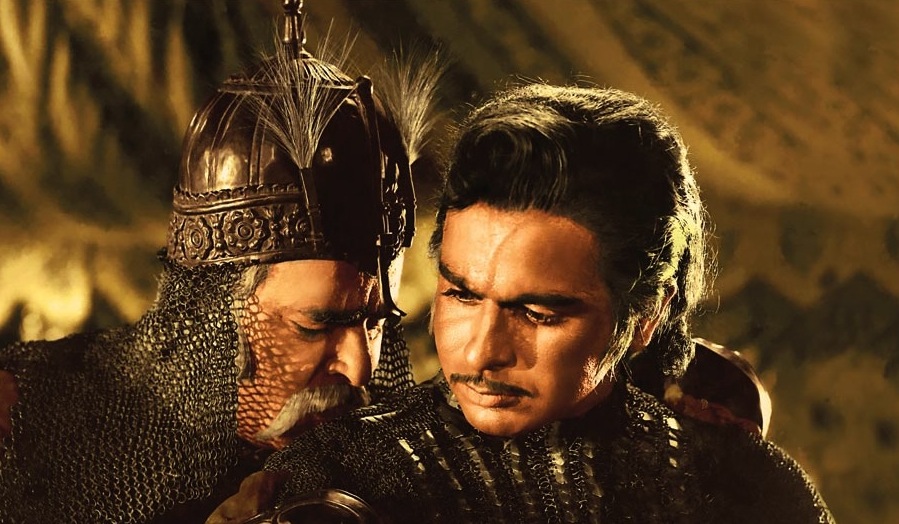
The love story of a commoner, Anarkali (Madhubala), and Prince Salim (Dilip Kumar), the heir apparent to the Mughal throne. When his father, Emperor Akbar (Prithviraj Kapoor), finds out, he is furious and does his best to thwart the romance, saying a commoner could never be the empress of India. Salim, however, is adamant and rebelliously leads an army against his father. He is defeated in battle and brought before Akbar who sentences him to death. Anarkali agrees to sacrifice her life for Salim to be spared and after spending the night with him, is taken to be entombed alive in a brick wall…
The Anarkali-Salim legend is unsupported by historic evidence but the story of thwarted youthful love in conflict with convention and authority provides rich dramatic material with immense popular appeal. It is no surprise therefore that this popular legend has been filmed many times on the silver screen, but Mughal-e-Azam is perhaps the definitive version of the doomed love story.
Mughal-e-Azam hit the screens in 1960 after about fifteen years in the making, its initial cast being Chandramohan, Nargis and Sapru in the roles finally played by Prithviraj Kapoor, Madhubala and Dilip Kumar. Produced at a cost of Rs 1.5 crores in those days filming took over 500 working days! It was easily the costliest Indian film till date. Tailors were brought from Delhi to stitch the costumes, Hyderabad goldsmiths made the jewellery, Kolhapur craftsmen the crowns, Rajasthani ironsmiths fabricated the shields, swords, spears, dagger and armour, specialists from Surat-Khambayat were employed for the exquisite zardosi embroidery on the costumes while the elaborate footwear was ordered from Agra! For one of the songs, Ae Mohabbat Zindabad, there was a chorus of 100 singers used!
Premiered simultaneously in 150 theatres all over the country, the film became the biggest money grosser in those times. In a rave review, Filmfare wrote “Mughal-e-Azam is a tribute to the imagination, hard work and lavishness of its maker… For its grandeur, its beauty and the performances of the artistes it should be a landmark in Indian films.”
The breathtaking battle scenes, the sumptuous splendour of the Mughal Court, some of the most evocative song and dance ensembles ever filmed, the confrontation scenes between Akbar and Salim, the passionately intense love scenes between Salim and Anarkali – the best of Mughal-e-Azam has never been surpassed and is the finest testament to its maker K Asif’s cinematic talents.
That is not to say the film is without its little flaws. In his anxiety to show Akbar as a compassionate king and to provide his film with a so-called happy ending, Asif changed the popular legend by letting Anarkali escape through the false bottom of the wall that opens out into a tunnel unknown to Salim. This, however, weakens the narrative and defies the internal logic of the otherwise tragic love story.
The performances, too, are a mixed bag. Dilip Kumar has his intense moments but looks strangely uncomfortable in places in the role of Prince Salim and Prithviraj Kapoor does go over the top as Emperor Akbar. However, his robust voice and regal bearing still carry him through his obviously theatrical act and it is to his credit that he is still the first name remembered by old-timers when they talk about actors who played Akbar. At the other end of the coin, Durga Khote is splendid as Rani Jodabai caught between her husband and son but it is Madhubala, who is the life of the film as Anarkali. An immensely underrated actress, Mughal-e-Azam showed off the finely modulated depth she could bring to her performances if given the opportunity. It is without doubt the greatest performance of her career and one of the all-time best performances by an actress in Hindi cinema. That she lost the Filmfare Award for Best Actress that year to Bina Rai (Ghunghat) is shocking. Nigar Sultana is fine as Bahar, Anarkali’s rival, who also loves Salim, as is Ajit playing Salim’s loyal friend who stands by him no matter what. Veteran actor Kumar makes a strong impact in his dynamic cameo.
Of course, the highs far outweigh the lows. Naushad’s superb musical score stands out, particularly the two songs by noted classical singer Bade Ghulam Ali Khan (Shubh Din Aayo and Prem Jogan ke Sundari Pio Chali). It was indeed shocking that he lost the Filmfare award that year to Shankar-Jaikishen for their populist score in Dil Apna Aur Preet Parayi (1960). The film also sees some of the finest singing by Lata Mangeshkar of her career (Mohabbat Ki Jhooti Kahani Pe Roye, Mohe Panghar Pe, Pyar Kiya Toh Darna Kya, Humen Kaash Tumse Mohabbat Na Hoti, Bekas Pe Karam Keejeeye), while Mohammed Rafi excels in hitting the high notes in Ae Mohabbat Zindabad. RD Mathur’s expansive camerawork lifts the film even higher, particularly the song Pyar Kiya To Darna Kya shot in colour in the famous Sheesh Mahal or Palace of Mirrors. The film deservedly won Mathur the Filmfare Award for Best Cinematography.
And last but not least, Mughal-e-Azam has perhaps the most sensitively portrayed erotic scene ever on the Indian screen as Dilip Kumar tickles the impassioned face of Madhubala with a white feather shot mainly in extreme close-ups of the two. Simply, magical!
Hindi, Urdu, Historical Drama, Black & White and Color
https://www.youtube.com/watch?v=TdOS-0sIW-Y
Devdas established DILIP KUMAR AS A KING OF TRAGEDY
MUGHAL E AZAM is MADHUBALA movie
and also: Prithviraj Kapoor. Well, the film is named after his character
Sudhir /// May 27 2022