


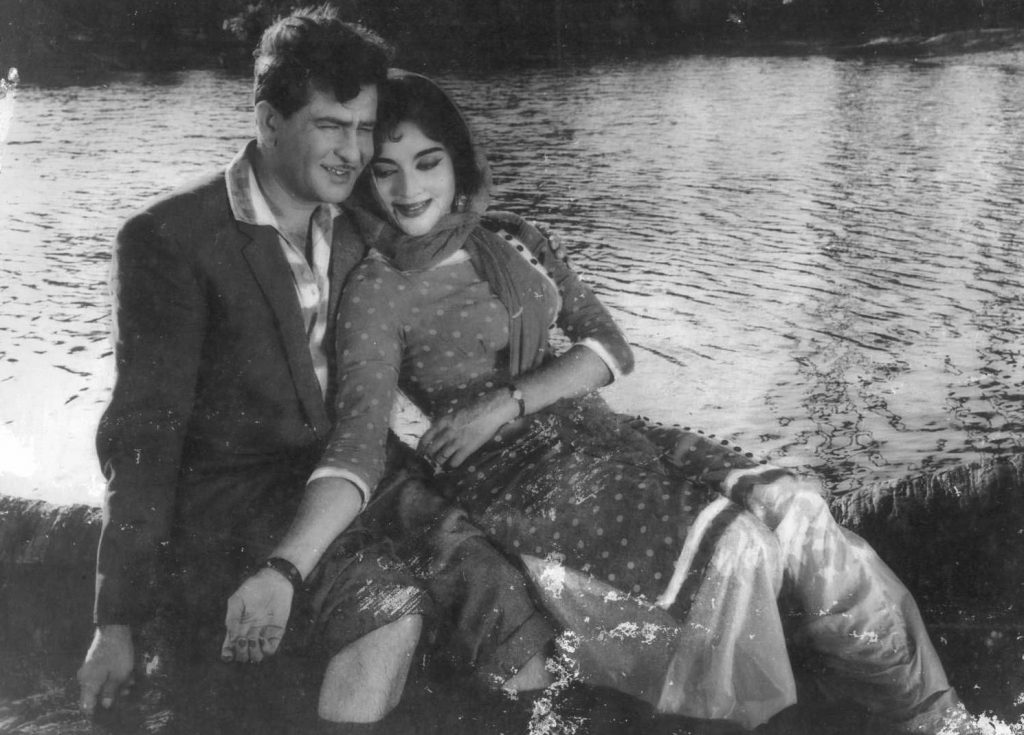
Raj (Raj Kapoor) and Vasanti (Vyjayanthimala) are college mates who fall in love. Raj rents the room upstairs in her house and Vasanti’s elder sister Geeta (Usha Kiron) also falls in love with him. Vasanti sacrifices her love for her elder sister who has educated her and leaves the house. Raj and Geeta marry and have a son. Vasanti joins them but Geeta suspects there is something on between them and finally kicks Vasanti out. On finding out the truth, Geeta falls ill and dies in guilt making Raj promise that he will make Vasanti their child’s mother…
CV Sridhar made his directorial debut with the super-hit Tamil film Kalyana Parisu (1959). Re-making the film, he makes his Hindi directorial debut here with Nazrana. Raj Kapoor takes on the Gemini Ganesan role, Vyjayanthimala plays the B Saroja Devi character and Usha Kiron plays elder sister, Geeta. Interestingly, Gemini Ganesan plays the small role of Vyjayanthimala’s boss, played by A Nageshwara Rao in the original. Also, B Saroja Devi did begin shooting for Nazrana, reprising her role from both, the Tamil and the Telugu version, Pelli Kanuka (1960), also directed by Sridhar. In the Telugu film, A Nageshwara Rao took on the role of the hero, while Jaggayya plays Saroja Devi’s boss. However, in the Hindi version, she was ultimately replaced by Vyjayanthimala.
Nazrana works well enough as a typical melodrama that the South filmmakers made in Hindi. The film requires a high degree of suspension of disbelief as it opens with a 36-37 year old Raj Kapoor and a 27-28 year old Vyjayanthimala winning various events at the college sports day (yes, they are college goers)! However it settles down to watchable fare once the love triangle takes shape even if the film is full of dramatic and even silly sacrifices being made by various characters throughout the film.
Talking of the love triangle itself, it has to be said that the falling in love of Vasanti and Raj is handled much too abruptly and quickly, whereas the sequences of Geeta falling for Raj are well worked out, nicely built up and are credible right from the first time Geeta sees him to her nursing him when he is ill. Raj not relating to Geeta after marriage is well brought out and shows he is only human as he was forced to marry her. His changeover towards Geeta too works well enough as Vasanti makes a valid point when she tells Raj that their sacrifice is meaningless unless Geeta is happy.
Where the film really flounders are the lapses into high melodrama and obvious symbolism that the South filmmakers normally favoured. For example, when Vasanti realizes that Geeta loves Raj too, the symbolism of the weighing scale superimposed on Vasanti’s face with Geeta on one side and Raj on the other looks tacky and is unintentionally funny as the scales on either end go up and down. Some sequences simply belie logic. Like Geeta, in her maternal home for her delivery, asks Vasanti to dress up as a bride in front of her just so the director can have Raj walk in and be stunned seeing Vasanti in bridal finery as they both see what might have been. Or Vasanti on reading the newspaper advertisement by Geeta asking for forgiveness and to come back home decides the best way would be to go as a married woman so Geeta would have no reason to suspect her now and so agrees to marry Gemini Ganesan!
The climax takes the take. Geeta, after realizing that Vasanti and Raj loved each other, makes Raj promise that he will make Vasanti their child’s new mother after she dies. Raj promises and Geeta dies thinking this will bing Raj and Vasanti together. But as Raj reaches Vasanti by the time she’s married, he leaves his son with Vasanti with a note saying Geeta is no more and she wanted Vasanti to be Raja’s new mother and having left Raja there, walks away! (Yes, yet another sacrifice and one that is truly gobsmacking!)
The South also has the habit of having some extremely wierd angles and shot taking passing off as technical virtuosity without realizing that shots need to be taken according to the story dictates. There is this extremely strange shot of tilting down to Gemini Ganesan and Vyjayanthimala’s reflections on Gemini’s desk when he confides his feelings to her!
All central performances are fine though it must be said that Raj Kapoor and Usha Kiron come off best with their comparitively restrained, sincere performances even if Raj Kapoor’s role is undemanding by and large. Vyjayanthimala, however, follows the old South dictum and gives a performance that has its high moments, as it is she who initiates events in the film, but her acting at times tends towards high eye-popping melodrama like for instance the sequence where Geeta confides to Vasanti that she loves Raj and Vasanti ‘reacts’ to this. Achala Sachdev lends adequate support in her usual motherly role. Gemini does whatever he has to, adequately.
Ravi’s music is a definite asset with some sweetly composed melodic songs among which include Mere Peeche Ek Deewana, Zulfon Ko Bikhrake, Baazi Kisine Pyaar Ki and the two Diwali songs used quite well in both happy and sad versions.
Nazrana opened up the National audience for Sridhar as he went on to making more films in Hindi including Dil Ek Mandir (1963) and Pyar Kiye Jaa (1966). Hindi film audiences would see yet another reworking of this film with the Jeetendra-Sridevi-Jaya Parada starrer Tohfa (1984).
Hindi, Drama, Black and White