


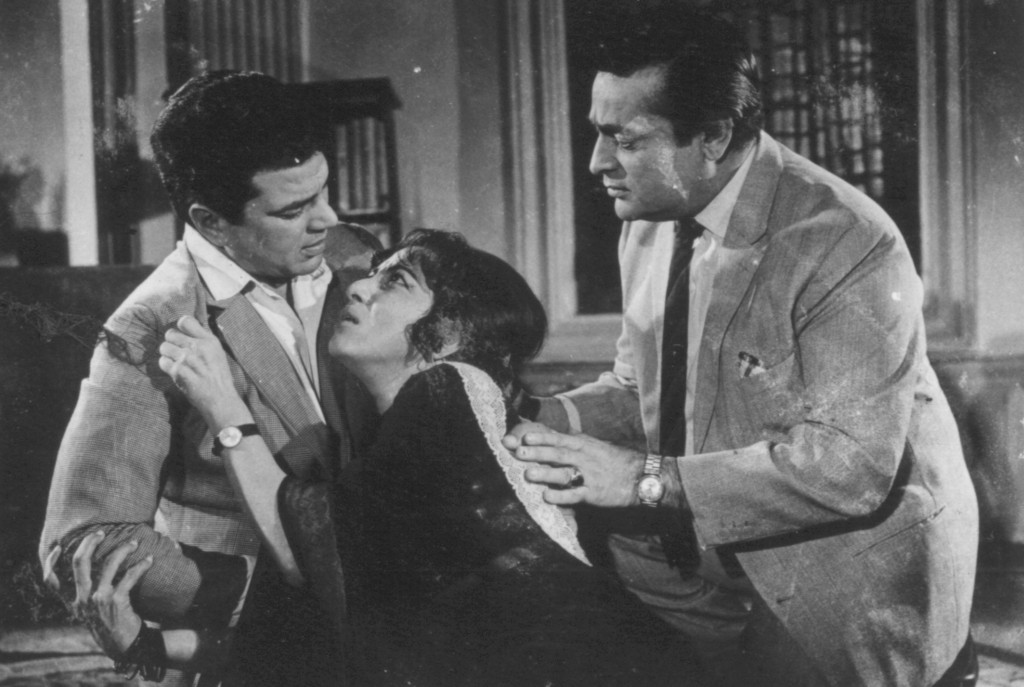
Newspaper managing editor, Amita (Mala Sinha), and her younger sister, Sunita (Tanuja), both find themselves falling for the paper’s idealistic news editor, Jeetendra (Dharmendra), while the corrupt Board of Directors of the paper want him out.
Advertised as Guru Dutt’s last offering (he passed away on 10th October, 1964 during its making), one wonders if the final version (supervised by Dutt’s brother, Atmaram, and writer, Abrar Alvi, with Dharmendra replacing Dutt) bears any resemblance to Guru Dutt’s original vision. I would say practically none whatsoever. In fact, there is very little in the final film that bears the ‘Guru Dutt touch’ at all and several portions of the film must have had him turning in his grave!
The film, inspired from the old New Theatres Hindi-Bengali bilingual classic President/Didi (1937), is a tale of two sisters in love with the same man but reset in a newspaper office as against a cotton mill in the earlier film. Rather than a conventional love triangle (actually, the film is a quadrangle with the elder sister’s colleague (Rehman) silently in love with her), a strong focus of the film is, in fact, on the relationship of the two sisters.
While the basic idea has great potential, the film suffers from a plodding screenplay that gets more and more absurd as the film progresses. In fact, after a fairly interesting title sequence, the film takes much time to take off as a lot of time is wasted on inane comic scenes of Johnny Walker. While the sequences between Dharmendra and Mala Sinha leading to his dismissal and subsequent reinstatement and promotion, and the bits of Sinha’s falling in love with him are reasonably well-worked out, the subsequent sacrifice saga of the two sisters – with each trying to give up her love for the other – looks ridiculous. That the climax with Sinha going insane and dying is ludicrous, is an understatement.
Among the performances it is really only Tanuja as the younger sister, Sunita, who stands out. A natural spontaneous performer she is the life of the film – bubbly and vivacious as she feels the first flush of love, and serious when she has to be. Dharmendra seems to be merely going through the motions, clearly not too interested with the focus being on the two sisters as it is.
Mala Sinha gives one of her typically unbearable, melodramatic acts in the central role of the older sister. As she goes insane and simultaneously has a heart attack in the film’s climax, Mala has enough elements to play with to go totally haywire, thus resulting in some of the worst overacting ever!
Yet, there are other scenes in the early parts of the film, particularly in the editorial office, where Sinha is actually quite pleasantly restrained as also in the Woh Hanske Mile Humse song. While it is well-known that Dutt had shots some of the office scenes and the Aapke Haseen Rukh Pe song. I would like to think that he might have done this other song as well. The long takes, well-worked out camera movements and beautiful play of light and shade through the song suggest Guru Dutt’s familiar style of filming. Those involved with the film recall Dutt worked especially hard with Sinha to ‘tone down’ her performance! Rehman and Johnny Walker do whatever they have to, which isn’t much, adequately enough.
As in many older Hindi films, it’s the music by OP Nayyar that lifts the film a notch. Initially, SD Burman was hired to compose music for the film and even recorded a tune for the title track. But things didn’t work out and OP Nayyar, another Guru Dutt regular, stepped in. Hearing Nayyar’s compositions for the film, Guru Dutt had commented that OP Nayyar composed feelings, not just music. The film sees some of Nayyar’s finest compositions – Badal Jaye Agar Maali (picturzed pretty dully inside a train), Aapke Haseen Rukh Pe, Woh Hanske Mile Humse Hum Pyar Samajh Baithe – one of the finest Asha Bhosle sad songs, Koi Kehde, Dil To Pehle se Madhosh Hai and the lighthearted Johnny Walker ditty – Suno Suno Miss Chatterjee.
And what of the tune SD Burman had composed? He simply re-used it as a lovely Kishore Kumar solo, Yeh Dil Na Hota Bechara, in Jewel Thief (1967)! You can, however, hear the song intended initially for Baharen Phir Bhi Aayengi scored by Burman dada and sung by Mohammed Rafi here.
Hindi, Drama, Black & White
Header photo courtesy Arun Dutt