


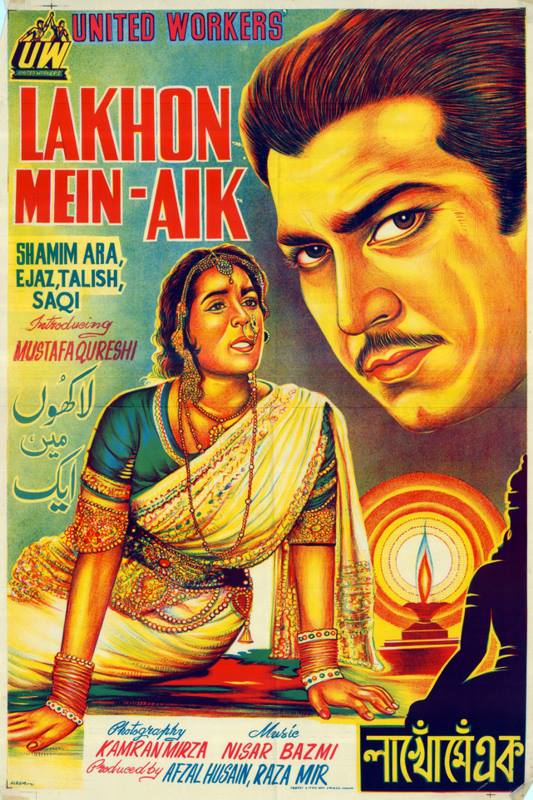
Khairabad, Azaad Kashmir, 1948. As the situation is tense, Ahmed Ali (Agha Talish) arranges for his Hindu Brahmin friends, Hardayal, to depart for India. As Hardayal’s little daughter, Shakuntala, cannot be traced, he leaves without her. Thankfully, Shakuntala is found later and taken in by Ahmed. Meanwhile, Ahmed hears of his family’s slaughter on the other side in Prem Nagar. Unknown to him his young son, Mehmood, has survived but has lost his memory after being hit by a stone. He is found and brought up by a kindly Pathan, Dilbar Khan (Saqi), a truck driver who names him Dildar Khan. Meanwhile Ahmed defends Shakuntala from a Muslim mob, shaming the group into leaving her alone by quoting the Prophet’s teachings. The story moves to 15 years later. Shakuntala (Shamim Ara) meets and falls in love with Mehmood/Dildar, now a truck driver (Ejaz Durrani). He too falls for her. Both Ahmed Ali and Dilbar Khan thwart the romance due to the religious differences between Mehmood and Shakuntala. Disturbed, Mahmood has an accident where he gets his earlier memory back as Ahmed’s son. He is reunited with his father. However, he forgets his his love for Shakuntala but recalls her as a little girl when they played by the river. But after being told of his love for Shakuntala by Dilbar Khan, Mehmood falls in love with her again. Hardayal returns after spending years in a mental asylum in India for trying to stop Hindus from killing Muslims. He takes Shakuntala back with him to India where she is married off to a Hindu man, Madhusudhan Lal (Mustafa Qureshi), a forest officer. When he finds out about Shakuntala’s past, he decides to call Mehmood to the border to kill him. Shakuntala, coming to know of his devious plan, goes to the border to warn Mehmood. As she attempts to cross the border, Madhusudhan shoots her fatally. Mehmood kills Madhusudhan in a fight to the finish and returns home with Shakuntala’s body…
Lakhon Mein Aik is considered one of the most sensitive, balanced and brilliant films to come out of Pakistan. What’s more, this film having an Indo-Pak love story as its central thread – perhaps the earliest film to do so – is supposed to have ‘inspired’ Raj Kapoor to try his own take on the subject, Heena (1991), which ultimately son Randhir Kapoor directed as a tribute to his father, who passed away before the film could be made.
Sadly, Lakhon Mein Aik is neither sensitive nor balanced as claimed. It is, in fact, unabashedly biased especially if seen from the Indian viewpoint. Coming shortly after the India-Pakistan war of 1965, the hostility towards the ‘other’ is apparent. The tone is set right from the opening shot of the film following the credit titles where we see a beautiful scenic shot on which is superimposed ‘Azaad Kashmir, 1948!’ In the film, barring the heroine and her father, every Hindu is depicted as a negative character. And Hardayal suffers in India for his kindness towards Muslims by having to spend years in a mental asylum! Madhusudhan Lal, whom Shakuntala marries, is the villain of the film. The priest who arranges this match is corrupt and greedy and later plots with Madhusudhan how to get rid of Mehmood. The devotees of the temple Hardayal and Shakuntala go to are cruel to them on account of her being ‘polluted’ for having lived in Pakistan for sixteenths years. On the other side barring the Muslim mob that came to attack Hardayal and demand that Shakuntala be handed over to them, all the major Muslim characters are shown to be good people. Ahmed Ali is the moral keeper and conscience of the film. Dilbar Khan, who brings up Mehmood after his family is slaughtered by Hindus, is a kindly soul. And Mehmood, of course, is the good hero. Only the conman astrologer Ramzani, who also covets Shakuntala is a troublemaker but is more of a harmless buffoon.
That’s not all. In the climax when Madhusudhan goes to the border to kill Mehmood, Shakuntala dies trying to save him. The film might suggest that Shakuntala died for peace and humanity to survive, but the subtext seems to say otherwise. Shakuntala might have been brought up by a Muslim and even loved a Muslim, but she has now become ‘impure’, having married a Hindu. She has to thus redeem herself not just by dying, but dying to save a Muslim. To think that this film was scripted by no less than Zia Sarhadi, an unaffiliated Marxist inspired by the IPTA style of filmmaking (Hum Log (1951), Footpath (1953)), makes it all the more surprising. Sure, patriotism is one sided and biased and Indian films too like Gadar: Ek Prem Katha (2001) have done their share of Pak-bashing from this side of the border but they make no claims to being impartial. Lakhon Mein Aik does.
The screenplay, though having its odd moments, is weak overall and while technically and aesthetically, the film is one of the better made films across the border, still that isn’t saying much at all. The performances, rated so high in Pakistan, have not held up in many parts; especially so in the developing love story between Shamim Ara and Ejaz Durrani. Not only is the development abrupt after the first two meetings, it doesn’t help that Shamim Ara overplays the cute, feisty village belle bit till it grates. Thankfully, she is adequate enough and generally at home in the more serious and dramatic portions of the film. Echoing the trials and tribulation of her namesake in Hindu mythology as she was forgotten by her husband, King Dushyant, so too does she have to suffer as Mehmood as Dildar forgets her. Ejaz, never a great actor to begin with, doesn’t change your perception of his wooden histrionic ability. Agha Talish as Ahmed Ali easily comes off best with a sensitive performance. Saqi is fine as the kind-hearted Dilbar Khan while Mustafa Qureshi makes a loud enough screen debut as Shamim Ara’s villainous husband, thus starting off on a glorious career of villainy in Pakistan.
The highlight of the film is easily its music. Lakhon Mein Aik has some wonderful songs composed by Nisar Bazmi and rendered amazingly well by the one and only Noor Jehan. The songs are some of the finest songs she has sung in Pakistan – Chalo Achha Hua Tum Bhool Gaye, Ho Sun Sajna Dukhi Man ki Pukar, Bahut Mushkil Se Hua Tera Mera Pyar Piya and Man Mandir Ke Devta among others. Mehdi Hassan gives fine support with his rendering of Dil Diya Dard Liya. The bhajan, Man Mandir ke Devta, was banned by Radio Pakistan but the records sold like hot cakes. However, its placement in the film and picturization just leaves you speechless, coming as it does on the ‘suhaag raat’ od Shakuntala and Madhusudhan. Mustafa Qureshi slaps and roughly pushes Shamim Ara aside after she tells him she loves another – the classic “you may possess my body but never my heart” type of dialogue! What follows is astounding. The film arbitrarily cuts to the song wherein Shamim Ara dances in a temple before a deity which becomes Ejaz. As the two look dreamily into each other’s eyes, Mustafa Qureshi enters and shoots at Ejaz with Shamim Ara coming in front of him! And then we come back to her having just been pushed aside by him. It’s gobsmacking to say the least!
The film went on to be a huge success at the box office in Pakistan and won Nigar Awards for Best Actress (Shamim Ara), Best Supporting Actor (Saqi), Best Sound, Best Camera, Best Female Singer (Noor Jehan) and Best Lyricist (Fayyaz Hashmi).
Critics in Pakistan lapped up the film and even today claim it to be superior to Heena, which, truth be told, has a far stronger humane message. But if you actually want to see a Pakistani film dealing sensitively with the Partition, watch the Punjabi drama Kartar Singh (1959) instead. Lakhon Mein Aik‘s biggest legacy, still continuing, may be its mirroring the Romeo-Juliet theme onto the Indo-Pak love story, where the lovers are opposed not just by their families, but by their religions and nationalities as well.
Urdu, Drama, Black & White
Header Photograph courtesy Omar Ali Khan