


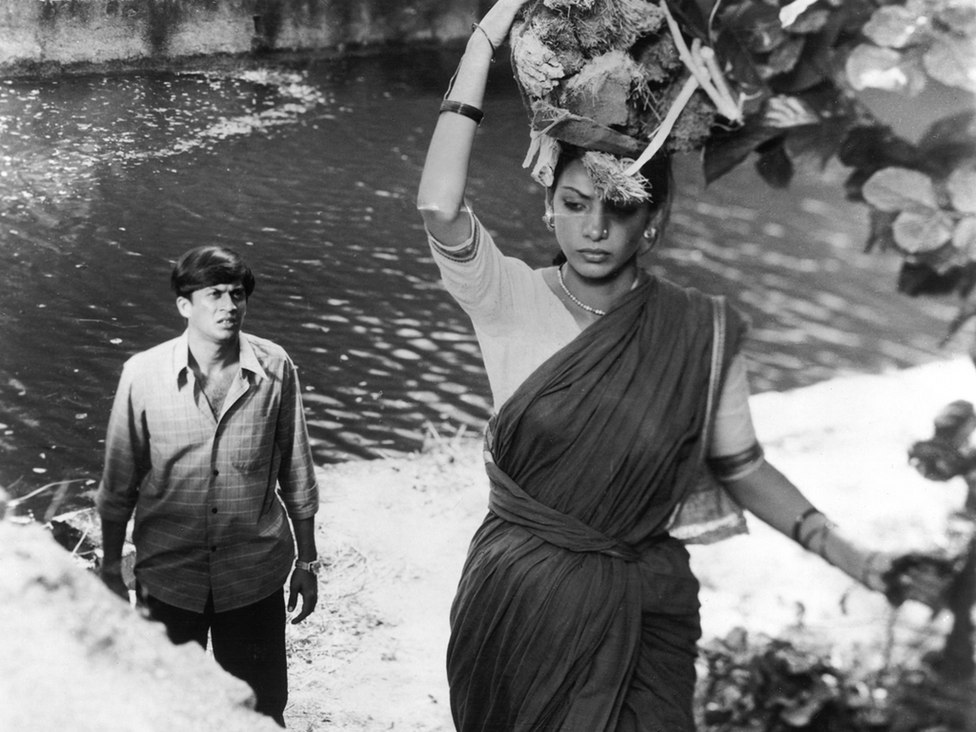
Surya (Anant Nag), the college-going son of a well-to-do farmer is forced into giving up his studies in order to look after the family property. He is married against his will to a young girl, Saryu (Priya Tendulkar), who would join him when she attains puberty. Bored and lonely in his farmhouse, Surya finds himself attracted to his maidservant Lakshmi, (Shabana Azmi), wife of a poor deaf-mute potter Kishtaya (Sadhu Meher) but she spurns his advances. Kishtaya is caught stealing Toddy and is punished. Humiliated, he runs away from the village. Lakshmi, now destitute gives in to Surya who promises to look after her. Their brief idyllic association ends with the arrival of Saryu who senses their past relationship and dismisses Lakshmi. Lakshmi, who is now pregnant, wakes up one morning to find Kishtaya beside her, giving her the money he has earned in his absence. What’s more, he appears pleased at her approaching motherhood thinking the child to be his. Kishtaya goes to Surya asking for work and to tell him the good news. In a frenzy of conflicting emotions and fearing exposure, Surya beats him mercilessly. Lakshmi rushes to her husband’s rescue and tells Surya off.
Ankur marked a brilliant directorial debut for Shyam Benegal and a film which immediately gave him National prominence. The film is rightly regarded as one of the defining films of the Indian New Wave or the New Indian Cinema as it was called. Based on an actual incident in the Hyderabad area, the film focuses on power and privilege – not in the standard hero-villain or black & white terms but delving in deeper with a fine sense of understanding and maturity. The film is memorable for its engrossing details of rural life and its exposure of a feudal system that is both brutal and indifferent. But more than anything, it is primarily a study of human relationships with its strengths and weaknesses and it is this facet of the story which gives it wider significance.
Before he embarked on Ankur, Benegal had made quite a name for himself as an advertising filmmaker. Blaze Advertising, which dominated the booking of advertisements at cinema theaters, proposed backing Benegal in making a feature film as they had surplus funds to invest. Benegal immediately got the scenario for Ankur out of the closet and went to work. He had earlier tried for years to get funds for it but was unsuccessful.
In Ankur, Benegal’s direction shows a fine understanding of the cinematic craft and a good control over storytelling. The women particularly are directed with much empathy and sensitivity and his handling of crowds suggest a seasoned virtuosity. The sounds of nature are omnipresent – the rustle of leaves in the wind, the chirruping of birds – and the colorful photography carries a warm golden glow. Benegal shows a keen eye for composition and his use of a tracking camera adds dramatic impetus to the script; at other times he is content to let the actors create their own tension – Surya being shaved in front of his house, or the moving return of Lakshmi’s husband near the end. The final act of rebellion when a small boy throws a stone at the landlord’s window foreshadows much of Benegal’s later work. The film also sees the use of Hindi with a ‘Hyderabadi’ accent being deployed by the characters keeping in tune with the area where the story is set.
Ankur is greatly aided by a sensational performance by Shabana Azmi in the central role of Lakshmi. An acting alumnus of the Film and Television Institute of India, (FTII), Pune, it is hard to believe it is her first feature film. It is a sensitive, mature pyschologically penetrating performance and deservedly went on to win Shabana the National Award for Best Actress, her first of five. Ironically Shabana wasn’t even the original choice for the film. Benegal had earlier met Waheeda Rehman, Sharadha and even Anju Mahendru for Lakshmi’s role but they all refused. Then he met Shabana, fresh out of the Institute and cast her in the film, altering the script a little to suit her age and making Lakshmi a younger woman.
Shabana is prefectly supported by rest of the cast including Sadhu Meher – who also received a National Award for his performance, Priya Tendulkar and Anant Nag. Again neither were Priya and Anant original choices. Zarina Wahab refused Priya’s role and the actor playing Anant’s role got jaundice. Benegal then recalled Anant had come along with the actor for the audition and felt he was suitable for the role. The rest as they (always) say is history. Not only did Ankur kickstart Anant Nag’s acting career, but it also led to a fine working relationship between him and Benegal.
Ankur won a host of awards the world over and what’s more, the film was a success at the box-office too thus setting the basis for a fine career as a filmmaker for Shyam Benegal. In fact, the success that New India Cinema enjoyed in the 1970s and early 1980s could largely be attributed to Benegal’s quartet Ankur, Nishant (1975), Manthan (1976) and Bhumika (1977), which were artistically superior yet commercially viable films, not pandering to commercial ‘items’. Tapping fresh talent mainly from the FTII and NSD like Shabana Azmi, Naseeruddin Shah, Om Puri, Smita Patil, Kulbhushan Kharbanda and Amrish Puri, Benegal has made several sensitive and stimulating films since which have been appreciated by both the classes and the masses.
Hindi, Drama, Color
https://www.youtube.com/watch?v=S9-68zxtFDs