


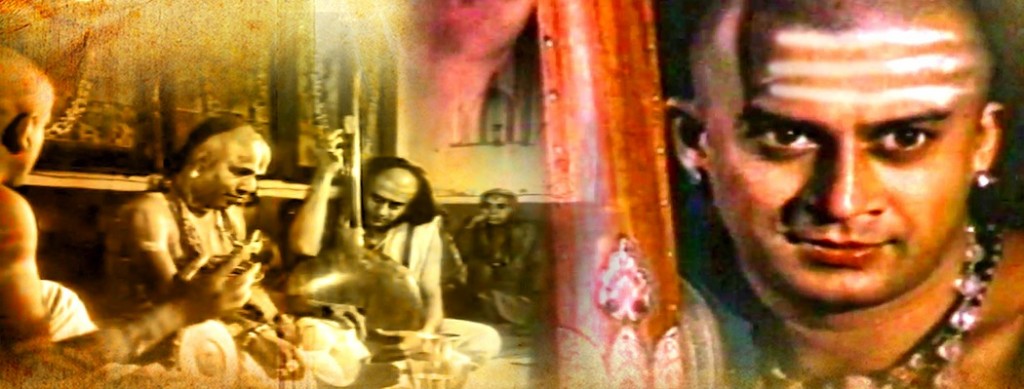
After a great deal of hardships, a brilliant rookie singer Venkatasubbaiyya (Anant Nag) manages to convince a reluctant but enigmatic vagabond, living amidst huge boulders and ruins, to teach him the finer aspects of music. Before he dies, the vagabond asks Venkatasubbaiyya to master a musical raga. Back home, Venkatasubbaiyya is inducted as a court musician. As he becomes widely popular, he falls prey to the false prestige that fame normally begets. After a public humiliation during a music concert he realises his mistake. He returns to nature, gets isolated amidst huge boulders as he resumes his practice and his singing. But his love and lust for a courtesan makes him mortgage two of the musical ragas that he is well versed with, to a moneylender. Despite societal objections, he opts for a blissful live-in relationship with the courtesan. Later on, his well-wishers get the mortgage released. Free to sing the two ragas, Venkatasubbaiyya once again returns back to nature, gets isolated amidst the boulders, to practice and sing for the rest of his life. Years later, when his land is invaded, Venkatasubbaiyya is asked to sing in front of the invaders king. But he prefers to cut his tongue instead.
Hamsageethe or The Swan Song is considered as one of the prominent film representing the body of work that that took shape during the 1970s, now called as the Kannada New Wave Cinema. They were films that dealt with subjects that were hitherto untouched while some of them also tried new forms of cinematic expression. Director GV Iyer was a well-known actor, writer, director and producer of Kannada language mainstream cinema for over thirty years when he decided to make Hamsageethe. By then Iyer had already reinvented himself by producing an off beat film like Vamsavriksha, directed by Girish Karnad and BV Karanth.
Hamsageethe is based on Ta. Ra. Subbarao’s Kannada novel by the same name. Set in medieval Karnataka, the book narrates the story of a fictitious rebel singer called Venkatasubbaiyya and his tryst with art and life. The novel is weaved together by the writer, who as a character in the book is doing research on the singer. The persons he meets reveal different aspects of the singer’s life. By the end of the novel, the reader gets a complete picture of the life of the singer. In GV Iyer’s interpretation, he does away with this writer-narrator character. Thus, the film takes an episodic form, narrating the singer’s life through a succession of loosely connected incidents. The classical structure of story telling in its strictest sense – the crisis-conflict-climax kind of situation – is never followed. There is no integrated plot where sequences are bound by immediate causes and effects.
Iyer also does away with the dialogue-to-dialogue shot taking style that is so prevalent in mainstream cinema. To provide an example, there is a sequence where Venkatasubbaiyya’s teacher ends his life. Over music, there is a close up of a person cutting grass. The camera zoomz out as he gets up. The person walks carrying a stack of hay. He hears Venkatasubbaiyya’s voice asking him if he had seen his teacher. The person points out at a direction. Far away in the pond, we see a body floating. Cut to a handheld point of view shot of someone running on the rocks. Venkatasubbaiyya and his friend run towards the pond, the former jumps into it and swims towards the body. The camera then zooms out from the dead body of the teacher at the bank of the pond to reveal that Venkatasubbaiyya and his friend are sitting besides it. Both are as still as the dead body.
In fact, the film has very few dialogues. Most of the story in the film is told through characters who sing. Most plot points occur in song sequences – the competition where the ward beats the teacher, the musical exchange that happens when the vagabond teaches Venkatasubbaiyya, the humiliation Venkatasubbaiyya faces when he sings in a public concert, or when Venkatasubbaiyya cuts his tongue even as he sings. Like in a true musical, the songs do no act as mere interludes to dialogue sequences, they are a narration in themselves. While the songs composed by the Carnatic music maestro Dr Balamuralikrishna is a treat to all music lovers, what binds Hamsageethe more than anything else is its background music provided by BV Karanth.
It is a widely held view that the Western music is an ideal form of music when it comes to films. The different layers of harmonious music and instruments that form a symphony is ideally suited for the rapid changes of emotions that occur between shot to shot. Through his mesmerising background score, Karanth achieves this symphony like quality through the minimum tools that were available to him – human voices that sing the ‘alaap’ and the tampura. Sometimes, a single voice is used to sing a single tune and some times a set of voices sing the same tune. Some other times, a different set of voices simultaneously sing different tunes. Many times, the pitches of these different voices vary with each other. And then there are male voices and female voices. The volumes of different voices are played around with. One voice or a set of voices appear prominent at one given point of time; suddenly within the same musical piece, a different set of voices gain ascendancy. Such subtle change of music results in the subtle change of moods and emotions in within sequences and within shots. It would be difficult to imagine Hamsageethe without its background score.
Equally interesting is the film’s sound design. The usage of howling sound of the wind amidst the huge boulders, or the Sanskrit mantras that resonate at Venkatasubbaiyya’s parental house, or the simple sound of the string movement of the tampura or the multi layered voices of children learning music employed in the various music classes when Venkatasubbaiyya goes in search of a new teacher – all stand out.
But there are a few questions. The excessive usage of the zoom lens in the film has more of a déjà vu effect and gives it a dated look. An important plot point where Venkatasubbaiyya mortgages the two musical ragas to the moneylender is communicated by just a single voice bite. Did this need more screen time? It is also not clear as to why Chandrasaani was drowning in the pond, the night Venkatasubbaiyya saves her. In the later part of the film, after developing the Venkatasubbaiyya-Chandrasaani love angle in great detail, why is Chandrasaani completely forgotten? After she helps the mortgage gets released, her utility seems to be over for both Venkatasubbaiyya and the filmmaker. These issues throw you off a bit, but I would like to assume that these are deliberate acts and omissions.
Hamsageethe is a film about a classical singer who liked to live on his own terms. He is an outcaste, a rebel who appears to be different from the rest of the society. Like the mainstream cinema, the Kannada New Wave too did create some of its own stereotypes – the isolated eccentric artist is one among them. When Hamsageethe first got released, a lot of us did get drawn into this stereotype. Half a lifetime is what it has taken to know that it was just that – a stereotype, albeit a fresh one during its times.
Kannada, Historical Drama, Color