


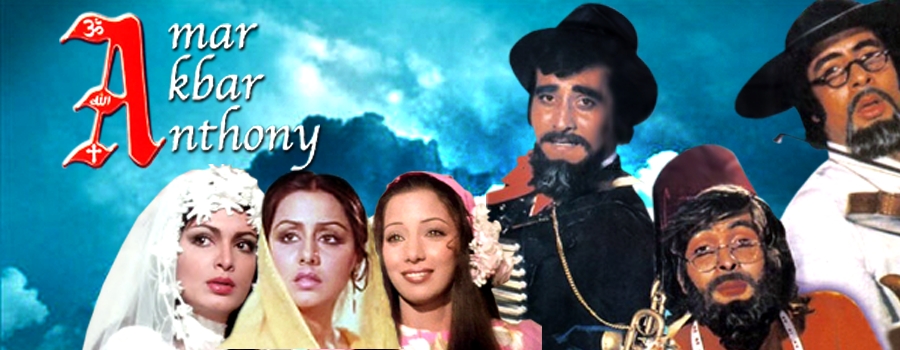
Kishen Lal (Pran), a driver employed with Robert (Jeevan), a smuggler, goes to jail for a crime that is actually committed by the latter. In return, Robert promises to take care of his wife, Bharati (Nirupa Roy) and his three sons. However, on his return, Kishen Lal finds his wife suffering from Tuberculosis and his sons fighting with each other over food. Fuming with anger, Kishen Lal goes across to seek revenge from Robert, however he faces humiliation from his employer. He escapes with booty and takes his sons along with him. His wife, not being present at home, is left behind. He leaves his sons at a park and then goes on to divert his enemies and the police from his path. However, his car meets with an accident and falls off the cliff but Kishen Lal survives. The police, seeing this accident, assume that he along with his sons are dead. Bharati gets the news of the death of her husband and sons and is completely shattered. Meanwhile, the eldest son Amar (Vinod Khanna) is adopted by a police officer. A priest of a church adopts the second son, Anthony (Amitabh Bachchan), while an old muslim tailor adopts the youngest son, Akbar (Rishi Kapoor). Amar becomes a police officer, Akbar a qawwali singer, and Anthony a lovable crook. They find romance with Laxmi (Shabana Azmi), a small time thief, Salma (Neetu Singh), a doctor and the daughter of Tayabali (Mukri), a wood merchant, and Jenny (Parveen Babi), the daughter of Robert. The film finally moves towards the re-uniting of the lost family with the sons seeking revenge on Robert.
Amar Akbar Anthony became a legend and by far the most successful entertainer of its time. Released in 1977, it was a super hit and is considered easily the best film made by Manmohan Desai, the undisputed king of the lost and found formula. A typical Desai ‘masala’ film, it has the apt quantity of the necessary ingredients like action, emotion, drama, comedy and tragedy. According to Desai, the film’s story itself was inspired by a news item about an alcoholic who regularly beat up his wife. One day, the distraught woman, abandoning her three small children on the curbside, disappeared. This gave Desai the idea to show each one growing up in three religious households, Hindu, Muslim and Christian.
From this germ of an idea, the film grew into an incredibly implausible yet highly absorbing tale. Escapism is part of experience when viewing a Manmohan Desai film, and this film is filled with many a moment that makes it so memorable. The scene where Amitabh is drunk and is applying the medicine on the mirror to his reflection is by far is the best portrayal of a scene of this kind and continues to inspire many actors till today. The action sequence between Amitabh and Vinod Khanna with both of them in their vests, resulting in Amitabh getting thrashed are some of the few nostalgic moments. The wearing of vests by the two of them was largely merchandised through press and hoarding form of advertising and was visible all over the country. Apart from this, the scene where Amar, Akbar and Anthony are introduced as they simultaneously donate blood to their mother, highlights the vision of the director and his ability to successfully carry off even the most illogical situation convincingly. One also can’t forget the scene where Amar re-unites with his father while digging out his toy, a pistol given to him by his father when he was a kid.
The film’s highlight apart from its story, screenplay, dialogue and direction is the character of Anthony Gonsalves played by Amitabh Bachchan. The character is that of a local Christian of Bombay and it became immensely popular because of his language and mannerisms and was a rage through out the country. In fact, it made the ‘Bambaiya Hindi’ popular all over the country. An interesting fact to know was that Anthony Gonsalves was actually inspired from a man of the same name who used to live in Khetwadi, an area in Mumbai where Manmohan Desai also lived. His unique mannerisms had always impressed Manmohan Desai, who decided to incorporate this in his film. The film, undoubtedly, sees one of Amitabh’s best performances ever. It gave him immense popularity and catapulted his position and career to unmatched heights and to super stardom. It also gave a whole new dimension to his acting career and the success of the film showed that he was more than just being the ‘Angry Young Man’ of Hindi Cinema.
The multi-starrer also has Vinod Khanna, an honest police officer, and Rishi Kapoor, a qawwali singer in the other lead roles of Amar and Akbar respectively; both of whose characters lend able support to the script. The film does bring out a sense of communal harmony with the brothers being brought up as followers of different religions. What’s more the brothers constantly keep running into each other every second scene but are unaware of the fact that they are blood brothers. The actresses in the female lead are, however, placed as mandatory requirements to the film. Parveen Babi, Shabana Azmi and Neetu Singh basically fulfill the requirements of glamour and romance even if Parveen Babi does get the best deal of the three. Among the supporting artists, Mukri playing Neetu Singh’s father stands out and deserves a mention.
The music of the film was fairly successful with all the tracks topping the charts. Parda Hai Parda, My Name is Anthony Gonzalves, the title song and Tayabali Pyar Ka Dushman are remembered and hummed till today. In fact, the music fetched Laxmikant-Pyarelal the Filmfare award for the Best Music that year, despite the tough competition from RD Burman (Hum Kisi Se Kum Nahin (1977)) – an award they won after a span of eight years. Incidentally, talking of awards, it also won the Filmfare award for Best Editing and got Amitabh his first Filmfare award for Best Actor.
Amar Akbar Anthony remains a cult favorite in the minds of the people and still attracts houseful audiences whenever it is screened. This film also marked the beginning of the immensely successful team of Manmohan Desai and Amitabh Bachchan who would go on to do several memorable films together.
Hindi, Drama, Comedy, Action, Color
While actual anthony gonsalves is said to be a pianist,the fight scene between Vinod Khanna who is a inspector by now and amitabh was incorporated by desai is said to be inspired from an actual event reportedly in which an infamous local gunda from mumbai slums of that time and the police inspector of the same place had a hand to hand fight .The article was published in a local newspaper and caught attention of desai when he was pondering about the face off of amar and anthony in the movie.In the actual event the thug challanged this brave inspector for a dual and the officer accepted this bet only for the villains demise.The arrogant thug was beaten badly the news article recalls,with proper masala and sound effects we had our greatest big bro lil bro face off ,which inspired the Ram Lakhan dual .