

![]() |
|
| Starring | |
| Directed by | |
| Creative Director | |
| Produced by | |
| Line Producer | |
| Story | |
| Screenplay | |
| Dialogue | |
| Cinematography | |
| Music | |
| Sound Design | |
| Action | |
| Editing | |
| Costumes | |
| Executive Producer |
Bela Negi - Editor, Writer, Director
It started with a news piece about a poor man in Assam winning a massive lottery. It set me thinking about the happy and not so happy repercussions of this windfall. Of how his expectations from life would be turned around and how he would try to acquire a new sense of respectability in the eyes of the world. So in the film the poor man has become a disillusioned poet who is trying to do something with his life and the lottery is a car. And the road to respectability becomes even more tenuous because of the incongruity of a bright red luxury car in a mostly roadless landscape of Uttarakhand.
Of course, the basic premise of the story could have also played out in the cityscape, since the fundamental concerns of people are the same everywhere. Yet the attitudes by which we address those concerns, the consciousness within which we frame our experiences, differ. And it is this unique worldview that has evolved in this little corner of the world, my homeland, which I hoped to evoke through my film.
It was also this context that allowed me to touch on certain issues (albeit in a light and humorous manner) of unemployment, brain drain from the hills, alcoholism, of a people still hoping to find their voice in the world. And of the stark reality that an average Uttarakhandi struggles for self-respect, his hopes and enterprise restrained by a lack of self-confidence.
At a more personal level, the driving force of the protagonist, the need for recognition and the limited vision of looking at himself through the eyes of other people, are the complexities that exist in most people, in me. So Ramesh Majila (the protagonist) is comic, absurd, helpless, sad, struggling with his own sense of personal identity. But there is a genuine need in him to make a difference, to reaffirm his sense of dignity. Surrounded by the mud-and-wood houses, with a cowshed in his basement, the heroism of it all cannot be overemphasized.
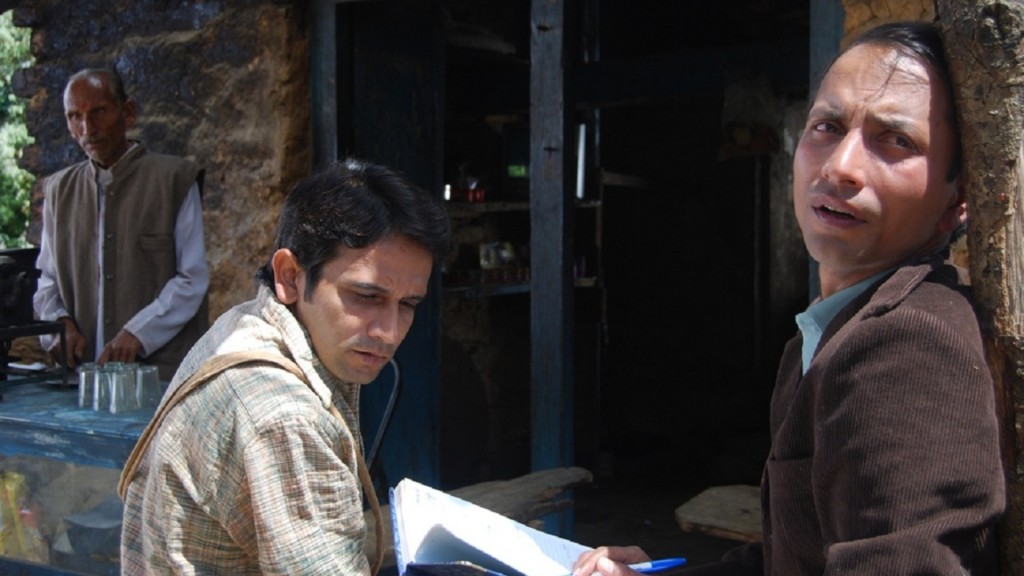
Deepak, Manav and Badrul are the only professional actors from Mumbai in the film. The rest of the cast is all local, some of them involved in amateur theatre but mostly villagers who are facing the camera for the first time. I didn't want actors from Mumbai pretending to be Uttarakhandi villagers.
The cast and crew held together, put their faith in each other. It was a tough shooting schedule - 48 days at a go with very limited resources at hand and a mostly outdoor shoot in the unpredictable weather of the hills. Even the city bred crew of the film did the long uphill walks almost everyday to get to location. There was no time to look daayen ya baayen, only to look ahead.
Amlan Datta - Cinematographer
It was my first 35mm feature film as well. I was surprised when one fine evening Bela asked me to shoot the film for her. She woke me up from my slumber. Mountains were calling. After twelve years since FTII, I came out to do something which I love the most - cinematography.
I drove our glamorous heroine of the film the red Chevrolet Optra magnum from Nainital to the village in the mountains of Uttarakhand, the main character of our film. Next two months I have been part of a classical love story from purbarag to shringar, from pratiksha, to milan, from vismay to bhakti.
On the road it's daayen ya baayen and on the sky it's dhoop ya chhaon. Either he's there or he's not there - the sun! Like the flight of the kite in the sad song I glided through the light and shadow trusting the winds to carry us. I have been meditatively shooting documentaries for the last five years and I have learnt how to trust nature, how to submit. I have learnt to intermingle with the reality where I become invisible. Where my camera is no longer an intruder to my subjects; actors, non-actors or the nature itself. I have tried to translate my faith into those images, not a mere recording of a reality but adding that feeling of a reality to a recording, that life into an image, which can feel.
My flight had been following a little girl in the valley picking up small flower like stories in her basket, Bela's childhood, which gave her the driving lessons to script for such an original road film. Well, I call it a road film, and a new road indeed!
Watching Daayen Ya Baayen is like visiting a place with someone who belongs there, who takes you to their home, and introduces you to their family, friends and neighbors. A writer goes back home to his village from the city, dreams of opening a cultural centre in the village, wins a red car in a TV contest, wins fame in his village, loses the car, loses his dignity, and chases through the hills to win his car and dignity back.
It is evident that the writer, director, editor Bela Negi's heart is rooted in the milieu of Uttarakhand. She weaves the narrative with little stories, little details, inflections of the voices, faces, the texture of the walls, and above all the hills. There is the impassioned poet Ramesh Majhila (Deepak Dobriyal), sure that he can change life in the village and bring self-confidence to its children with a cultural centre. But there are also his old, beedi smoking, cussing mother (Dhanuli Devi), his petulant, ambitious wife Hema (Bharti Bhatt), his naive sister-in-law Deepa (Aarti Dhami), his adoring son Baju (Pratyush Doklan), his side-kick friend Basant (Badrul Islam) and the village good-for-nothing Sunder (Manav Kaul). There are also scores of other little characters, the geography teacher who gets a student to knit for her in class, the principal of the school who can use "...and miles to go before you sleep!" on any occasion, the mining contractor who wants to exploit Majhila's car and fame to win an election seat, the old woman Harul-di who has been awarded 5 lakhs by the government 50 years after Independence for her freedom fighter husband and who gives it away to anyone who asks her for it, (for herself she needs only good walking shoes, and a packet of cigarettes), Harul-di's granddaughter and Deepa's friend Meena,, who would like to be called 'Kamakshi' after a popular television character and who pretends to be possessed by a devi for the benefit of the television cameras, the two drunkards who comment on government and Majhila's family life, every night as they pass his bedroom window.
All these and more, unravel village life like it is, the particular mischievousness of Uttarakhandi culture, a warmth coated with malice, a humor that can be rude and blatant but is overlaid with courtesy, and a genuine desire to help.
Almost the entire cast is from Uttarakhand, some with a little theatre and film experience, but a lot who have faced the camera for the first time. They bring a freshness to the film that belies the protagonist's concern that the people in the hills have everything but lack self-confidence.
Cinematographer Amlan Datta has worked on documentaries for several years. He brings that as a strength to this film. Some arresting visual moments like a rainbow in the mountains, a forest fire, and the first appearance of the mining contractor in a cloud of dust in the mines have been captured opportunely, adding great value to the film.
The camera remains static most of the time. Action is built within the shot. Humor is created by the framing, the play of light and shadow, the angles, none of which are deliberate or stylized, but just true to the emotion of the scene. Most scenes are executed in a shot or two, but none of them go by without bringing to life yet another detail of village life or character. This, coupled with the lively music track by Vivek Philip, keeps the pace engrossing even though there is nothing very dramatic in the narrative. When the camera does move, there is a purpose to it, particularly effective in the few crane shots during a scene where Majhila, Basant, Sunder and some other villagers lie down drunk in a field, after they have failed to find the car. Majhila recites a few lines of poetry and the camera moves across the friends, the surrounding fields and the hills evoking melancholy and the sorrow of virtually all adult lives.
Bela Negi touches on several problems that beset the village, alcoholism, a lack of will power, the distances which children have to travel to go to school, the quality of the education itself, the burden of work on women, the depletion of forests, the onslaught of television, but all these are woven into the story with humor, within the dialogue or shot-taking.
All in all, Daayen ya Baayen is a good directorial debut for Bela Negi. Sadly for her and those connected with it, the film is being released without any publicity whatsoever on October 29th. Do go for it - you'll be glad you did.
| Kalakalappu@Masala Cafe The style, craft, attitude and approach of Kalakalappu@Masala Cafe, reminds you of many films done like this, w... |
| Ishaqzaade Ishaqzaade makes you feel for Parineeti Chopra. She is simply outstanding in it but sadly enough, she needed a ... |
| Dangerous Ishq Vikram Bhatt’s obsession with all things supernatural is well-known. How else would you explain his recent indulgences -... |
| Vazhakku Enn 18/9 Vazhakku Enn 18/9 is riveting, luring you into a high voltage suspense crime story without the audience knowing... |
| Lakhon Mein Aik Lakhon Mein Aik is considered one of the most sensitive, balanced and brilliant films to come out of Pakistan. ... |
| Fatso The first half of Fatso is scattered with all the riches that we expect from great independent cinema - a relat... |
| Shamim Ara Shamim Ara was Pakistani cinema's top actress of the 1960s, taking over from the legendary Sabiha ... |
| Waheeda Rehman Waheeda Rehman was the embodiment of classic beauty with a truly transcendental appeal and also on... |
| Ellis R Dungan An American cinematographer, born in Ohio on May 11, 1909, an alumnus of University of Southern Ca... |


