


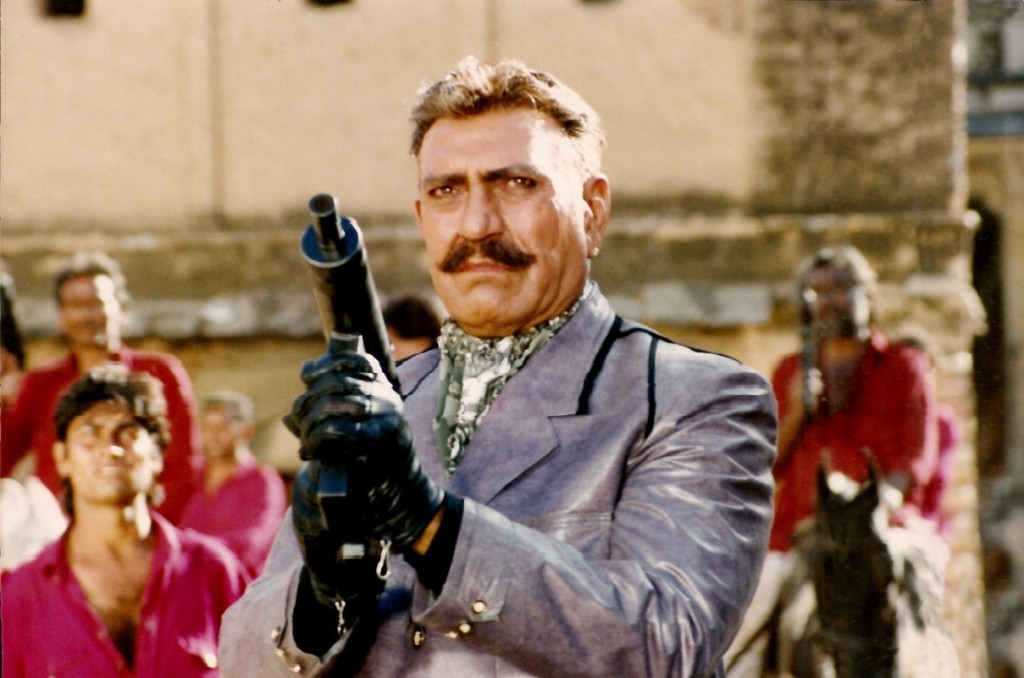
There have been two cult villainous performances in Hindi Cinema where more than the good guys, it was the villain firmly etched on the cinegoers’ minds. One of course was the dreaded dacoit Gabbar Singh (Amjad Khan) in Sholay (1975). The other was Amrish Puri’s brilliant comic villain Mogambo in Shekhar Kapur’s Mr India (1987). Think of Mr India and you immediately think of the evil Mogambo, his weird blonde wig, his dreams of taking over the world and… his catchphrase Mogambo Khush Hua. Amrish Puri was truly among the greatest villains in the history of Hindi Cinema, second perhaps only to Pran. But there was more to Puri than merely playing a bad man. He proved himself to be quite the versatile character actor, playing all sorts of roles with ease and confidence.
https://www.youtube.com/watch?v=P8ZavLj5S3g
Born in Nawanshahr in Punjab on June 22, 1932, Puri was the younger brother of another well-known actor, Madan Puri, with eldest brother Chaman Puri also in films. While both brothers played a variety of roles, they were known mostly for playing negative roles. Amrish Puri, too, tried his luck as a film actor but instead of following the path his brothers were on, he tried for leading roles in Hindi filmdom in the 1950s. However, his failure in a screen test to become a hero forced him take a job with Employees’ State Insurance Corporation (ESIC), Ministry of Labour and Employment, for survival and turn towards the world of theatre to satisfy his artistic cravings. Puri worked with Satyadev Dubey’s theatre group, Theatre Unit. It was on the stage that he honed his considerable histrionic abilities while his booming, well-modulated voice was used perfectly for advertisement voice-overs to keep the home fires burning. When he was nearing 40, the film world beckoned again. Puri played a small role in Dev Anand’s directorial debut, Prem Pujari (1970) and was offered a role in Sunil Dutt’s Reshma Aur Shera (1971) as well. However sadly for him, much of his role in the latter ended up on the cutting floor.
Puri continued to play small roles in films when he was cast by Shyam Benegal in Nishant (1975). Benegal had met him before when he was working with Dubey. According to Bengal, he was one of Dubey’ best actors and he, Benegal, had used Puri’s voice for commentary and voice overs for various documentaries and ad films. He even got him to dub for one of the characters in Ankur (1974) before deciding to cast him in Nishant (1975). Puri made an extremely strong impact in the film as an abusive zamindar and even more so in the latter’s Bhumika (1977). The film is broadly based on the life of well-known Marathi stage and screen actresses of the 1940s, Hansa Wadkar, who led quite a flamboyant and unconventional life. Puri gave an amazing performance as her dominant lover who takes her as his second wife and then stifles her freedom. In fact, his association with Benegal saw Puri doing some extremely fine work and made him a powerful actor to reckon with. Their films, where they worked together, include Manthan (1976), Kondura (1978), Kalyug (1981), Mandi (1983) and Sardari Begum (1996), besides the TV serial, Bharat Ek Khoj. Recalling Puri as an actor, Bengal mentioned that, “He had a very fine personality. He had a lean but very powerful build. He had a magnificent voice. His articulation was excellent.”
Commercial Hindi cinema opened its doors in a big way to Puri with the success of the modern day Mahabharat, Hum Paanch (1980). This small film proved to be the surprise hit of the year thereby launching the career of producer Boney Kapoor as well. Puri convincingly played the evil zamindar, who an analogy of Duryodana. This lead to Puri starring in a number of major films, initially playing one of the villains before graduating to playing the main villain of the film. He continued notching up hit after hit – Shakti (1982), Vidhaata (1982), Hero (1983), Meri Jung (1985) and Nagina (1986) among others. He was finally a star when well into his 50s, practically unheard of in Bollywood!
What’s more he even got called by Hollywood, Steven Spielberg no less, to play the villainous Mola Ram of the Thuggee cult in the second of the Indiana Jones films – Indiana Jones and the Temple of Doom (1984). Unfortunately, that film was the weakest of the series, showcasing the worst brand of ‘Indian exotica’ and even Puri’s role was nothing but a caricature. But yet he made his mark in the film. In fact, what made Puri stand out from other villains was the credibility he brought to each of his roles. Using his experience from theatre, Puri was able to give flesh to even the most one-dimensional cardboard characters he often had to play. Of course, the splendid use of that stern face, bulky build, incinerating impact of his bulbous, laser eyes helped a great deal!
Mr India took Amrish Puri to the peak of his career. This Shekar Kapur directed film created one of Bollywood’s most exotic charatcters – the comic villain Mogambo. Puri made the character his own, virtually walking off with every scene in which he is present. Following the success of Mr India, he was now as big a star as the leading men themselves. The hits continued to pile up – Ram Lakhan (1989), Tridev (1989) etc.
It is to Puri’s credit that even as he found such huge success in mainstream cinema, he continued to grace the theatre and act in parallel cinema. His work, particularly, in two films of Govind Nihalani stands out. He was brilliant as the public prosecutor in Aakrosh (1980) and simply stunning as Om Puri’s stern father in Ardh Satya (1983). This, in fact, led to the other variant of Puri’s roles. If his character were positive, then he would the stern patriarch of the family. This was seen sporadically in films like Mohabbat (1985) and Naseeb Apna Apna (1986) but him playing the tough father really took off after Dilwale Dulhania Le Jaayenge (DDLJ, 1995). In DDLJ, Puri played a strict NRI father with a soft centre – worrying his children are being led astray from traditional Indian values. His scenes with Shah Rukh Khan partucularly while feeding the pigeons are among the the highlights of the film. In an interview, Puri mentioned that he based some of his character’s inflections on his own strict and principled father, Nihal Chand Puri.
Thereafter it seemed no role was beyond Puri. While continuing to play the typical Bollywood villain to perfection, he played Sunny Deol’s terminally ill father bringing a lump to your throat in Ghaatak (1996) or the comedic strict father in the Utpal Dutt mould in Hrishikesh Mukherjee’s Jhoot Bole Kawa Kaate (1999). Strangely, while he won the Filmfare Best Supporting Actor Award for Ghaatak and Virasat, he never won for Best Villain, which was started in 1991 in spite of being the top villain of Bollywood right to his death. He was nominated several times though.
Puri’s last lot of films included Hulchul (2004) (the strict patriarch again!), Aitraaz (2004) and Subhash Ghai’s Kisna (2005). Some of his other memorable films include Saudagar (1991), Damini(1993), Gardish (1993), Pardes (1997), Taal (1999), Zubeidaa (2001) and Gadar: Ek Prem Katha (2001).
Amrish Puri passed away in Mumbai on January 12, 2005. He had been ailing for a while.
One of my fav actors. And he did a great job with his funny role in Chachi 420! 🙂
Akash,
He was an extremely versatile actor, no doubt!