


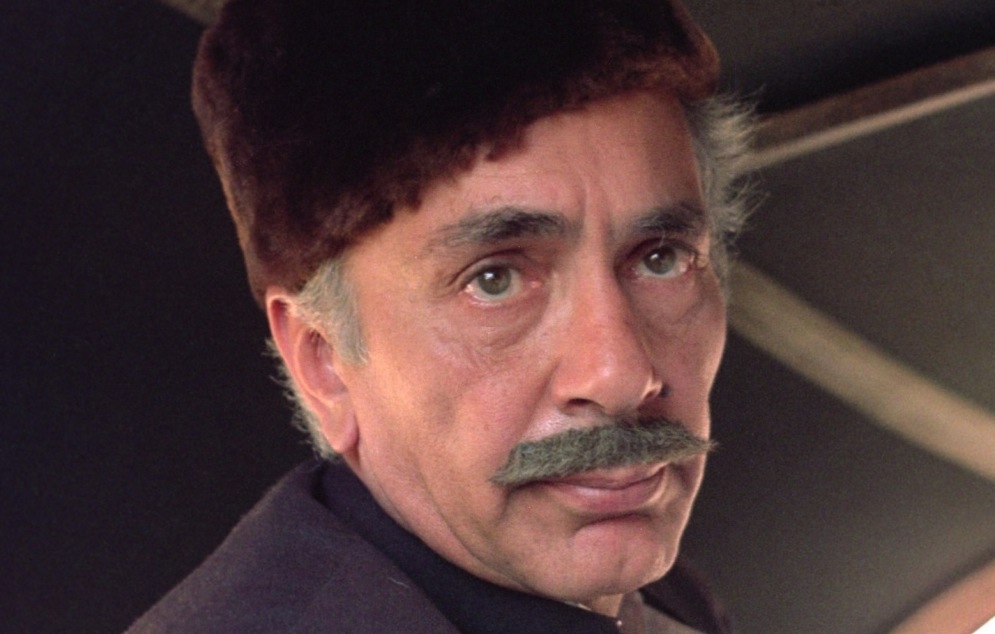
Balraj Sahni is perhaps the best known film actor in India to emerge from the post World War II Left Cultural Movements and one of Indian cinema’s greatest ever actors.
Born in Bhera (now in Pakistan) to a prosperous business family on May 1, 1913, he studied at the Government College of Lahore, graduating in Literature and then doing an MA in Literature as well. Absorbing the then prevalent desire for both Nationalism and Westernization, he started writing English poetry and got involved with ‘realist’ theater. He taught Hindi and English at Tagore’s Shantiniketan, and wrote his first compilation of Hindi fiction, Shahzadon ka Drink in 1936. He also worked as a journalist and briefly as a radio announcer for the BBC’s Hindi service in London – where he got exposed to Russian cinema, Marxism and Leninism – and also set up the Monday Morning journal in Delhi.
Sahni came to Bombay in 1946 and became a key figure in Indian Peoples’ Theatre Association (IPTA) plays. After a walk-on part in Phani Majumdar’s Insaf (1946), he starred in KA Abbas’s first film, Dharti Ke Lal (1946), the only film produced by IPTA. The film is set during World War II and the 1943 Bengal famine and a growing ‘Nation Building’ ideology. It’s symbol-laden realism realism proved extremely influential and set the pattern for many films moving from depictions of deprivation in the country to suffering in the city. IPTA had also become a political hotbed for communists and in 1951 as part of a Government Campaign against communists, Sahni was arrested. He was given special permission to shoot for K Asif’s production, Hulchul (1951), and would come to the sets escorted by policemen! However, he was released soon after and more than made his presence felt in Zia Sarhadi’s ‘realist’ film, Hum Log (1951).
Do Bigha Zamin (1953), directed by Bimal Roy, is perhaps Balraj’s Sahni’s greatest and most well-known film. The story of the dispossessed peasant and the moneylender/ landlord had been told many times before but with Do Bigha Zamin, Bimal Roy gives us a film that is very human and has great emotional depth. In the film, Balraj Sahni plays the peasant Shambhu who becomes a rickshaw puller in Calcutta in order to earn money and save his land in the village. It is a performance of extraordinary dimensions as Sahni literally becomes Shambhu. In the unforgettable ending of the film, the wretchedness of human defeat is writ large on Sahni’s face as he sees the factory built on his land. It is said that Sahni actually rehearsed for the role by pushing a rickshaw on the streets of Calcutta and interacting with other rickshaw pullers who were convinced he was one of them! Ironically, Bimal Roy was not sure of taking Sahni for the film because, as mentioned earlier, in real life he was well-educated and westernized, the total antithesis of Shambhu.
While sticking to his ‘realist’ imperatives in films like Garam Coat (1955), Anuradha (1960) and Kabuliwala (1961) (where he lived with kabuliwalas in a Bombay suburb for a month to prepare for the role!), Sahni went on to play leading roles in commercial films opposite actresses like Nargis (Lajwanti (1958), Ghar Sansar (1958)), Meena Kumari (Satta Bazaar (1959), Bhabhi Ki Chudiyan (1961)), Vyjayanthimala (Kathputli (1957)) and Nutan (Seema (1955), Sone Ki Chidiya (1958)) and what’s more, proved more than adept bringing much depth, grace and dignity to his characters. He also co-directed directed Lal Batti (1957), a film set in a train and on a lonely railway platform where passengers are forced to spend a night at the time of India’s Independence.
In the 1960s, Balraj Sahni shifted to character roles and left his mark with strong performances in films like Haqeeqat (1964), Waqt (1965), Do Raaste (1969), Ek Phool Do Mali (1969) and Mere Humsafar (1970).
Garm Hava (1973) was Balraj Sahni’s last major film before his death on April 13, 1973. The film, directed by MS Sathyu, chronicles the plight of the minority Muslims in North India and is set in Agra after the first major partition exodus. Sahni plays the central role of an elderly Muslim shoe manufacturer who must decide whether to continue living in India or to migrate to the newly formed state of Pakistan. He responded with an absolutely brilliant performance, perhaps his greatest ever, Do Bhiga Zamin, notwithstanding.
Sahni also wrote the story and screenplay for Baazi (1951) directed by Guru Dutt, though not a very happy collaboration as the two did not really see eye to eye. He wrote extensively on many issues including novels and an autobiography. He remained a Left Activist all his life and was part of cultural delegates to the Soviet Union and China. His writings and speeches were compiled by Communist Leader PC Joshi in the book Balraj Sahni: An Intimate Portrait (1974).
at 50+ age, he enacted ‘Ae Meri Zohra Jabeen’ with ‘josh and feeling
of a 20+ youth’ . It still is a highly enjoyable song to watch.
Mirza Ghalib, if had watched it from heaven, would have given a second
thought on his couplet:
‘Woh Valvale Kahan, Wo Jawani Kidhar Gayi’
ie the 2nd line of ‘shair’ ‘Maara Zamane Ne Asadullah Khan Tumhen ‘
Sudhir /// May 27 2022