


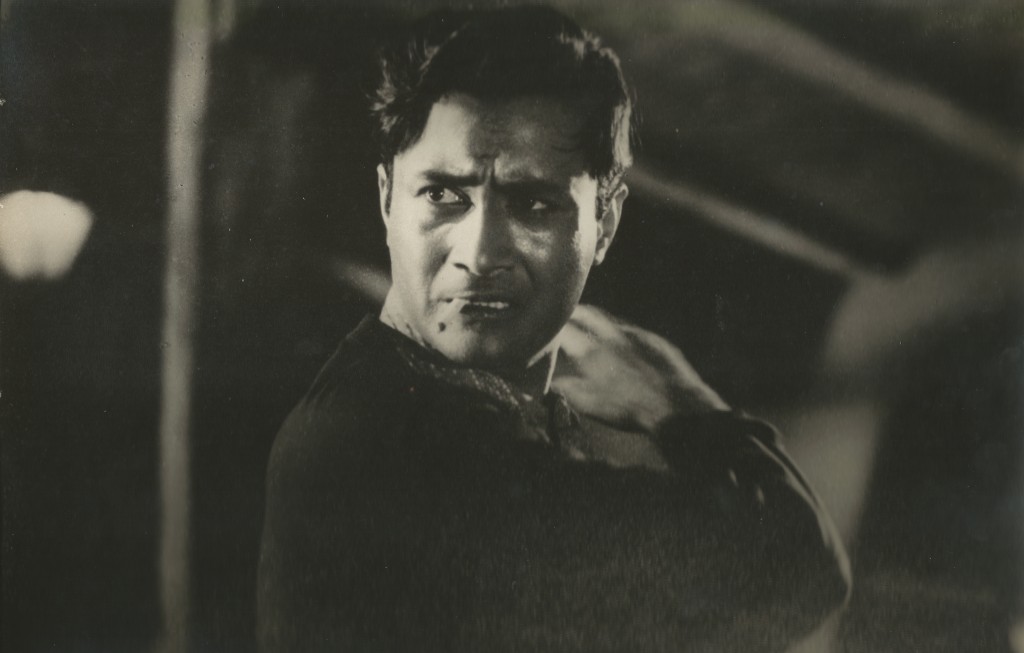
Dev Anand is one of the greatest stars the Hindi Film Industry has seen. Handsome and debonair, he was the epitome of the suave, urban gentleman and had one of the longest careers as a leading man, playing a romantic hero till well into his fifties.
He was born Dharam Dev Pishorimal Anand in Gurdaspur, Punjab, the middle son of a well-to-do advocate on September 26, 1923. He graduated in English Literature from the Government College, Lahore, and left for Bombay, looking to get a job. The initial years were full of struggle. Among other things, he had to sell some of his possessions including a prized stamp collection, and he even worked in the Military Censor’s office, reading soldiers’ letters to their families.
Dev Anand’s first acting assignment came in Pune with Prabhat’s Hum Ek Hain (1946) but the film didn’t do anything substantial for his career. The film, a plea for communal (and caste) harmony, had one the its heart in the right place though it failed to evoke the kind of response that V Shantaram brilliant Marathi-Hindi bilinguals on Hindu-Muslim unity did at the same studio – Shejari(1941)/Padosi (1941). Anand got noticed enough in Hum Ek Hain for the Filmindia magazine review to declare, “Dev Anand is a good second-rater and does pretty well as Shankar.”
At Prabhat, he met the young choreographer and assistant director of the film, Guru Dutt, thanks to a dhobi’s mix-up when each was given the other’s shirt. A deep friendship grew between the two of them leading them to promise each other that if Dutt were to turn filmmaker, he would take Anand as his hero. And should Anand produce a film, then he would take Dutt as its director!
Ziddi (1948) at Bombay Talkies was Dev’s first big success. The film, co-starring Kamini Kaushal and directed by Shaheed Latif, is also known for Lata Mangeshkar’s first ever hit song, Chanda Re Ja, composed by Khemchand Prakash. The following year Anand turned producer and launched his own banner, Navketan. Navketan’s first offering was Afsar (1950) starring Dev and his then lady love, Suraiya, and was directed by elder brother Chetan. A take off on Inspector-General, the film didn’t set cash counters ringing at the box office in spite of some great music by SD Burman, including that great Suraiya solos Nain Deewane and Man More Hua Matwala. Anand, remembering his promise to Guru Dutt invited him to make a film for Navketan.
Thus 1951 saw the release of Baazi, Guru Dutt’s directorial debut. The film, written by actor Balraj Sahni, was a trendsetter of sorts leading to the spate of urban crime thrillers Bollywood churned out in the 1950s. The film took Anand playing a man forced to turn to crime to pay for his sick sister’s treatment to dramatic star status. It was also the beginning of seeing Anand play mostly hard-bitten characters living in the urban under-belly. Baazi kickstarted several careers – Kalpana Kartik, Johnny Walker, Sahir Ludhianvi and changed singer Geeta Dutt’s image entirely. Known only for weepy, weepy sad songs and bhajans till then, Baazi made splendid use of the inherent sexiness in her voice as she went ‘western.’
But even as Anand started to get successful in films, sadly, his relationship with Suraiya ended as she could not take a stand against her strict and orthodox grandmother. Ironically after the split, her career went on the downslide thereafter even as his ascended – a total reversal of the days when they went around and she was the bigger star.
The next pairing of Dev Anand and Guru Dutt was Jaal (1952). Dev played a heartless smuggler who only repents right at the end of the film. It was a finely shaded performance but the film didn’t do too as well as Baazi at the box-office. The partnership came to an end when Guru Dutt decided to act in his own films. Anand did play the lead in CID (1956), produced by Guru Dutt and directed by Raj Khosla, playing an upright CID officer and the film, one of the best crime thrillers of the 1950s proved extremely successful at the box office. Today it is remembered for being the Hindi film debut of Waheeda Rehman, playing a vamp!
Anand, meanwhile, went from strength to strength and along with Dilip Kumar and Raj Kapoor ruled the Hindi Film Industry in the 1950s – they were known as the ‘Trimurti of Bollywood’. With deliberately awkward pastiches (owing their origins to Gregory Peck and Cary Grant), Dev revelled in playing the mischievous lover boy chasing the heroine. To quote Amit Khanna, “Dev Anand’s forte was the boy next door. Part lover, part clown, part do-gooder.”
At one end Anand played the fun-loving hero in frothy films like Munimji (1955) and Paying Guest (1957). Both films, written by Nasir Hussain, were responsible for bringing a more ‘bindaas’, playful hero to the fore in Hindi cinema, first epitomized by Anand and later by Shammi Kapoor. At the other end, Anand continued to play darker roles such as the pickpocket in Pocketmaar (1956), the absconding gang member in Dushman (1957), the black-marketeer in Kala Bazar (1960) or the murderer in Bombai Ka Babu (1960) though by now his starry mannerisms – his sing-song dialogue delivery, his puff in his hair, his total nonchalance were part of every character he played. Consequently, he was never rated too high as a performer but to be fair to him, he did give a fine performance under Raj Khosla as the anguished son trying to prove his father’s innocence in Kala Pani (1958), winning a Filmfare Award for Best Actor for the same, while Hum Dono (1961) saw him excel in a double role of two army officers.
Guide (1965) saw easily the best performance of his career. It is one of the most remarkable films of Indian Cinema and truly a film that was ahead of its times. Based on RK Narayan’s novel The Guide, the film is immortalized by director Vijay Anand’s bold, unconventional strokes; who would have dared to show a man and woman (Waheeda Rehman)living together outside the sanctity of a marriage way back in the 1960s? And that too in a milieu as traditional as that of Hindi cinema, which rarely allows nonconformist relationships even today! In fact, it is one of the earliest efforts in Indian Cinema to actually show its two leading characters as frail human beings who could make mistakes in life, and yet be unapologetic about it. Consequently, Anand, who also produced the film as well an English version for the International market, was advised by all and sundry not to touch this project with a bargepole but it speaks volumes of his conviction towards the subject matter that not only did he get a film made on it but a film that remains one of the landmark films of Indian Cinema. Anand also gave a a wonderful nuanced performance in the film, deservedly fetching him his second Filmfare Best Actor Award. The English version, directed by American Ted Danielewski, was both a commercial and critical failure.
Following landmark films like Jewel Thief (1967), Anand entered the 1970s on a high with another thriller, Johny Mera Naam (1970), and also took to direction with Prem Pujari (1970). His best efforts in this field were Hare Rama Hare Krishna (1971) and Des Pardes (1978). The former, set amongst Hare Krishna cultists (presented as dope-smoking hippies) was by far the best film he ever directed. The film launched the career of Zeenat Aman who made a tremendous impact as his sister in the middle of the cultists. Though he acted in films being made by other filmmakers like Joshila (1973), Shareef Badmash (1973), Warrant (1975) and Saheb Bahadur (1977), by the end of the 1970s and early 1980s, Dev Anand concentrated more on direction and mostly acted only in those films that he directed.
Other heroines Anand introduced include Tina Munim (now Ambani), Natasha Sinha, the late Richa Sharma and Ekta amongst others. He also tried to launch his son Suniel with Anand Aur Anand (1984) but was unsuccessful. And though he continued making films with regular frequency and launching more newcomers, none of the films really had any impact, commercially or critically, post Lootmaar (1980). Still, he kept going with unbridled energy and sticking to his policy of launching fresh talent, he did introduce Jackie Shroff (Swami Dada (1982)) and Tabu (Hum Naujawan (1985)), amongst others, to Hindi cinema.
On January 26, 2001 Dev Anand was awarded the Padma Bhushan for his contribution to Indian Cinema and the following year he was awarded the highest cinematic honour of the land – the Dadasaheb Phalke Award. In true Dev Anand fashion, on receiving the Phalke award, he dedicated it to his future!
On the personal side, Dev Anand married his co-star of 6 films Kalpana Kartik in 1954 – slipping away from the sets of Taxi Driver (1954) during a break and then resuming shooting after the marriage! The couple had two children – a son, Suniel, and daughter, Devina.
Dev Anand continued to make films right to the end with his last film Charge Sheet releasing in 2011. Quoting his philosophy of life, Dev Saab always used to say, “I never give myself a chance to get depressed. I think ahead.”
Dev Anand died of a cardiac arrest in his sleep in London on 3rd December, 2011. He had not been keeping too well for some time but as was typical to him, he was already planning his next film, when he passed away.
Dev Anand (1923-2011). The Evergreen star of Indian Cinema 📽️🎬🎞️📼📹. His career dates back to the 1940s’. As he said in an interview with Simi Garewal on YouTube- see her page Siga Arts International or just look it up, Rondevous with Simi Garewal. “I came to Bombay in 1945, looking for a job”. This is not the only documentary where he will make this statement. Even look up on YouTube Movie Mahal Between The Lines (1985-1987) he says the same thing. I have seen at least a dozen of his films from Baazi (1951) to Hare Rama Hare Krishna (1971). He was suave, debonair. As it is mentioned in this write up on Upperstall.com, he was part clown, part do-gooder. I really need to get a copy of his autobiography Romancing Life (among other books- reading material). Dev sahab, we all (film buffs, historians) salute you Sir!!
Thank you. I have made the correction.