


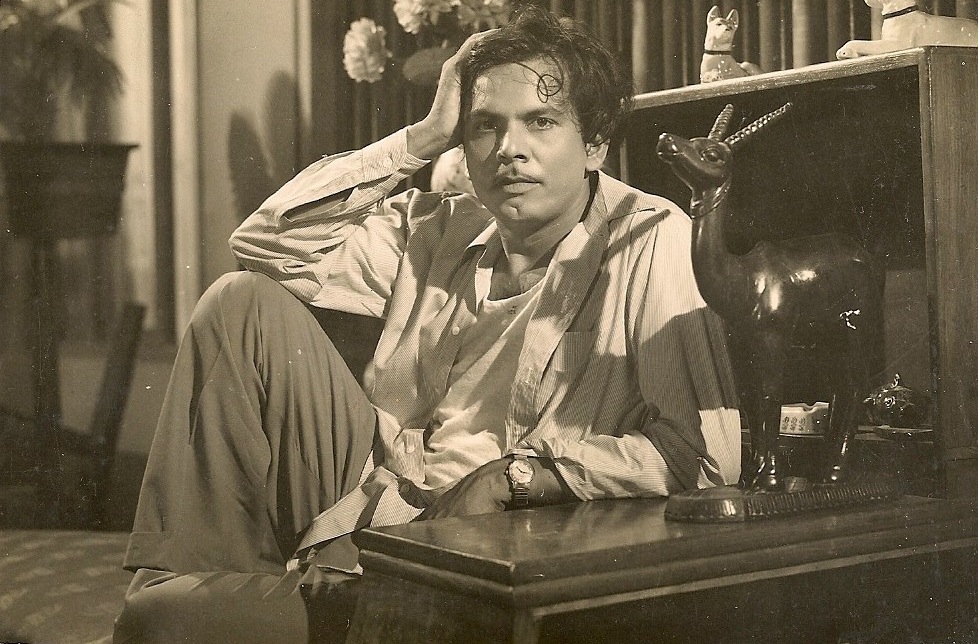
Johnny Walker was one of the most popular funny men in Hindi cinema in the 1950s and ’60s.
Born Badruddin Jamaluddin Kazi, the son of a mill worker on November 11, 1926 in Indore, he was discovered by Balraj Sahni who met him when he was working as a bus conductor. Sahni was most impressed with him regaling the passengers with an uncanny ability to hold them with improvised speeches. This got him the role of an extra in films and he used to entertain other people of the unit, often impersonating a drunkard during the lunch break.
He made his feature film debut in a proper role, small though it was, in Guru Dutt’s first film Baazi (1951) that, incidentally, was scripted by Sahni. It is said that Sahni instructed him to barge into Navketan’s office where Guru Dutt, Dev Anand and Chetan Anand were working. His routine as a drunkard impressed everyone, especially, once after the act was over, he was immediately back to his sober self. Thus despite the fact that Baazi was half complete, a role was developed specially for him in the film.
In his early films Walker was credited with his real name but his popular impersonations of a drunk seemed a natural reason for him to take on the brand name of a popular whiskey – Johnny Walker! Walker developed a characteristic style as the hero’s comic sidekick within the classic Indian film comedy tradition relying on his pencil thin moustache, facial grimaces and nasal drawl. People loved his squeaky voice and the faces he pulled – his smile reached his ear when happy and drooped low when he sulked.
Baazi led to a long-term relationship with Dutt who gave him some of his most memorable roles in films like Aar Paar (1954), Mr and Mrs 55 (1955), CID (1956), Pyaasa (1957) and Chaudhvin ka Chand (1960). He always had the best comic lines and some extremely popular songs in these films – Arre Na Na Na Na Tauba Tauba (Aar Paar), Jaane Kahan Mera Jigar Gayaji (Mr and Mrs 55), Yeh Hai Mumbai Meri Jaan (CID), Sar Jo Tera Chakraye (Pyaasa) to name a few. But it was give and take on both sides. If Guru Dutt gave him those roles and songs, then Johnny Walker also worked extremely hard to bring them to life.
Remembering his working method with Guru Dutt, Walker used to say: “He used to tell me – Here’s your scene, your dialogue. If you can do better, go ahead. In every rehearsal I would come up with something new. Guru Dutt used to love that. He used to look at everyone on the sets and see if the light boys, the cameraman, the assistants were laughing at my dialogues. Guru Dutt then had an assistant to write down whatever I said in the rehearsals. That’s how we worked.” In fact, Walker and Dutt were not just colleagues but fast friends as well, often going together for fishing and hunting expeditions.
Such was Johnny Walker’s popularity that apart from the Guru Dutt films, he worked with the likes of BR Chopra – Naya Daur (1957) and Bimal Roy – Madhumati (1958) and it was mandatory to have a song on him, which often would be the highlight of the film. Main Bombay ka Babu in the former and Jungle Mein More Naacha in the latter are remembered and hummed even today. He also won the Filmfare Award for Best Comedian for Madhumati, an award he would win again for Shikar (1968). Besides these, he starred in a series of films as a comic hero, often directed by M Sadiq and mostly opposite Shyama but also co-starring with actresses like the ‘Lara Lappa girl’, Meena Shorey, and Anita Guha as well. Some of Walker’s films as the leading man include Shrimati 420 (1956), Chhoo Mantar (1956), Johnny Walker (1957), Mr Qartoon, MA (1958), Zara Bachke (1959) and the Punjabi film, Vilayat Pass (1961).
His popularity began to wane in the mid-1960s as Mehmood took over from him as the top comedian of Hindi films but Walker continued working regularly right up to the late 70s and even sporadically into the 80s. But by them he found himself out of sync with the turn that Hindi cinema had taken in terms of its loud and crass comedic tracks. In an Interview, Walker recalled, “In those days we used to do clean comedy. We were aware that the person who had come to the cinema had come with his wife and children … the story was the most important thing. Only after selecting a story would Abrar Alvi and Guru Dutt find suitable actors! Now it’s all upside down … they line up a big hero and find a story to fit in. The comedian has ceased to be a character, he’s become something to fit in between scenes. … I opted out because comedy had become hostage to vulgarity. ”
Of Walker’s later work, perhaps his most memorable role was in Hrishikesh Mukerjee’s Anand (1970), where he gave Rajesh Khanna the immortal lines to tape before he died. He was last seen in a small but extremely enjoyable cameo as a make up man in the Kamal Hassan starrer Chachi 420 (1997). Walker also made a foray into direction and helmed Pahunche Huwe Log (1986) but the film flopped miserably at the box-office. Away from the movies, he also dabbled in the business of semi-precious stones.
Some other important films of Walker include Taxi Driver (1954), Milap (1955), Chori Chori (1956), Detective (1958), Paigham (1959), Ek Phool Chaar Kaante (1960), Mere Mehboob (1963) and Baharen Phir Bhi Aayengi (1966).
Johnny Walker passed away in Mumbai on 29th July, 2003. Reacting to his death, Atal Bihari Vajpayee, then Prime Minister of India, remarked how ‘his impeccable style lent a new meaning and respectability to the genre of comedy in Indian cinema’.