


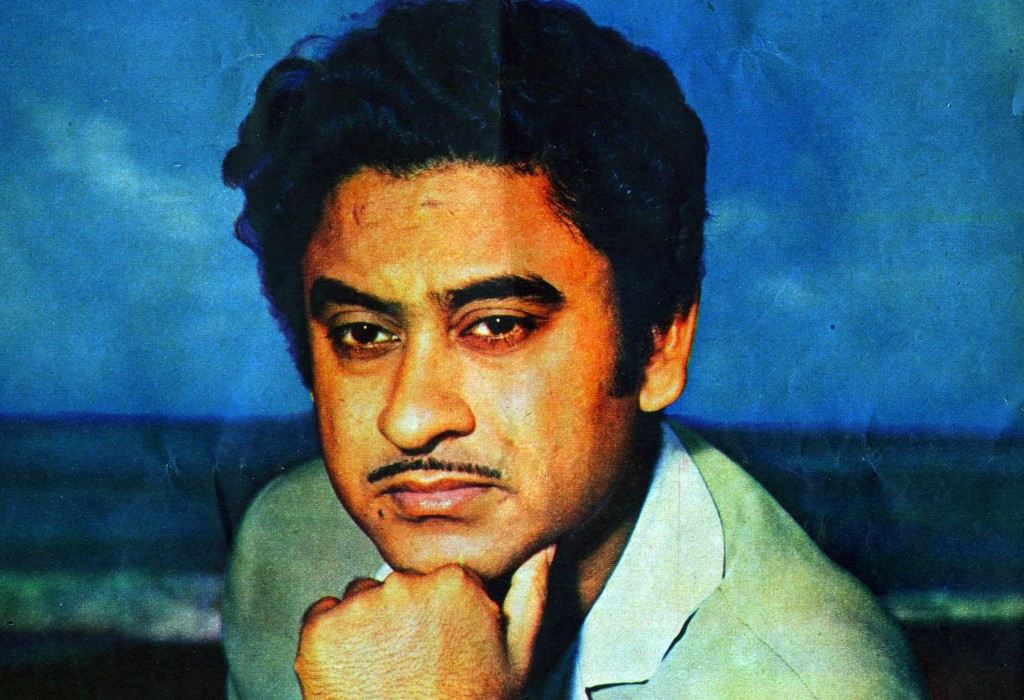
The traditional concept of a comedian has always been one of lowly stature, that of a sidekick. It was Kishore Kumar who successfully became Hindi cinema’s comic hero whose popularity relied primarily on his comic talents. Add to that his phenomenal acting talent and amazing singing voice and you have a performer who bordered on the genius. And like most geniuses he was notoriously eccentric!
He was born Abhas Kumar Ganguly in Khandwa on August 4, 1929. In his teens, he came to Bombay where elder brother Ashok Kumar was already a major star. Following being part of a group song in Shikari (1946), he got his first opportunity as a solo singer in Bombay Talkies Ziddi (1948) where he sang the song Marne ki Duaen Kyon Mangu for Dev Anand. Being an ardent admirer of KL Saigal, the song was sung in the style of the legend. But in spite of Ziddi’s success, Kishore found few offers forthcoming and did the odd singing assignment with bit roles making a rather tepid acting debut as hero in the forgettable Andolan (1951).
After his marriage to Ruma Devi resulted in a split in the family, Kishore approached SD Burman who had given him an opportunity in Pyar (1950), where interestingly he had sung for Raj Kapoor, for more singing work. Burmanda gave him the song Kusoor Aapka in Bahar (1951) which became a raging hit. As he got more singing assignments, he also began being offered leading roles in films.
Kishore was initially taken quite lightly as a singer and was given mainly lighter songs by Burmanda and other music directors. But with his soulful rendering of Dukhi Man Mere from Funtoosh (1956), Kishore was finally taken seriously as a singer. Though he was formally untrained, he assimilated jazz-scat fragmented musical notes into a rhythmic sequence and once its beat was established, departed from the pattern and combined notes and words/syllables into new kinds of musical harmony. And none could yodel better than he could!
On the acting front, by now Kishore was becoming a major star acting opposite all the top heroines of the day. He of course sang for himself and outside of that, he gave playback only for good friend Dev Anand. Though it is said he loathed acting and did everything to make himself a failure, it must be said that Kishore was in fact an extremely competent actor and not just in comedy. He could handle roles with elements of tragedy as well with ease.
An early film where Kishore made his mark as an actor was Bimal Roy’s Naukri (1954). Since his madcap comic persona had not yet developed totally and he was working with a director like Bimalda, Naukri sees an extremely sincere, sensitive and restrained performance from him. Kishore Kumar is totally at home be it the more serious scenes in the film or even in the comic scenes. The comic scenes however are not the typical slapstick Kishore scenes but lighthearted and gentle like most Bimal Roy scenes and bring a smile to one’s lips rather than uproarious laughter. The germs are obviously there for Kishore’s developing personality as a madcap comedian. The scene where he sings out his dialogue is apparently something he often did in real life himself!
With hit films like Baap Re Baap (1955), New Delhi (1956), Miss Mary (1957) and Asha (1957), Kishore reached his peak as an actor with the zany comedy Chalti ka Naam Gaadi (1958), directed by Satyen Bose, which starred all the three Ganguly brothers along with Madhubala. Kishore and Madhubala matched each other step for step brilliantly in this comic caper with SD Burman composing such wonderful lighthearted ditties as Haal Kaisa Hai Janab Ka, Ek Ladki Bheegi Bhaagi si and Paanch Rupaiya Barah Anna.
https://www.youtube.com/watch?v=PvlFaKKvRLk
After Kishore’s marriage to Ruma Devi disintegrated, he married Madhubala and remained with her till her tragic death in 1969, when just 36. The two starred in Jhumroo (1961), which Kishore produced and directed. He also composed the music of the film, which had some lovely songs like Main Hoon Jhum Jhum Jhum Jhum Jhumroo, Thandi Hawa Yeh Chandni Suhani, Koi Hamdam Na Raha among others. The riotous Half Ticket (1962) with the two of them saw Kishore at his madcap best impersonating a 12 year old! The duets Chand Raat Tum ho Saath and Aankhon Mein Tum became extremely popular from the film. They were also to do Shakti Samanta’s Naughty Boy (1962) together but Madhubala’s heart illness caused her to opt out of the film.
Door Gagan ki Chaon Main (1964) further confirmed Kishore’s phenomenal talent as he scored heavily in a rather serious film that he wrote lyrics for, composed its songs and directed, besides acting and singing. But the ’60s also saw Kishore fall from grace as beset by tax problems he was reduced to doing B-films with the likes of Kum Kum though films with the pair like Mr X in Bombay (1964) still did well at the box office. He scored heavily in Pyar Kiye Jaa (1966) and Padosan (1968) but they were supporting roles rather then the lead even as he did the odd singing assignment for Dev Anand in Teen Deviyan (1965), Guide (1965) and Jewel Thief (1967). He did work with the great Satyajit Ray in this period in perhaps the maestro’s greatest film, Charulata (1964). In the film, Amal (Soumitra Chatterjee) serenades Charu (Madhabi Mukherjee) with the famous Tagore song Aami Chini-Go-Chini, sung brilliantly by Kishore.
The turning point for Kishore Kumar came with Shakti Samanta’s Aradhana (1969). Though Burmanda used Kishore for what he called his second service, his songs for Rajesh Khanna – Mere Sapnon Ki Rani and Kora Kagaz Tha Yeh Man Mera proved super duper hits ahead of the Mohammed Rafi songs Baghon Mein Bahar Hai and Gun Guna Rahein Hain Bhawre for the same film. It was a second coming and there was no turning back now.
https://www.youtube.com/watch?v=lslZptXok8o
Kishore formed a solid hit pairing with Rajesh Khanna post Aradhana and in the early 70s the duo churned out hit after hit – Kati Patang (1970), Safar (1970), Amar Prem (1971), Andaaz (1971), Namak Haram (1973) and Aap ki Kasam (1974) to name some. Even the Rajesh Khanna films that flopped in the period had some extremely popular songs like Chala Jaata Hoon (Mere Jeevan Saathi (1972)), Ek Ajnabee Haseena se (Ajnabee (1974)) and Mere Naina Saawan Bhadon (Mehbooba (1976)). In the 1970s, Kishore overtook all competition and was the undisputed number one male playback singer of Hindi films, his voice pulsing with verve and exuberance. He was now the undisputed voice for all the top heroes of the day – Rajesh Khanna, Amitabh Bachchan, Dharmendra, Jeetendra, Shashi Kapoor, Randhir Kapoor and Rishi Kapoor.
As his fame grew so did stories of his eccentricities. He put up a board outside his house saying ‘THIS IS A LUNATIC ASYLUM.’ He reportedly spoke to his trees in his backyard addressing each by a special name. He zipped through a marriage with Yogeeta Bali which lasted just about a month and then married his fourth and final wife, Leena Chandavarkar, who was two years older than his son, Amit!
As a singer, Kishore remained at the top till the very end, succumbing to a major heart attack on October 13th, 1987, on elder brother Ashok Kumar’s birthday. Playback singing has never been the same in India since…