


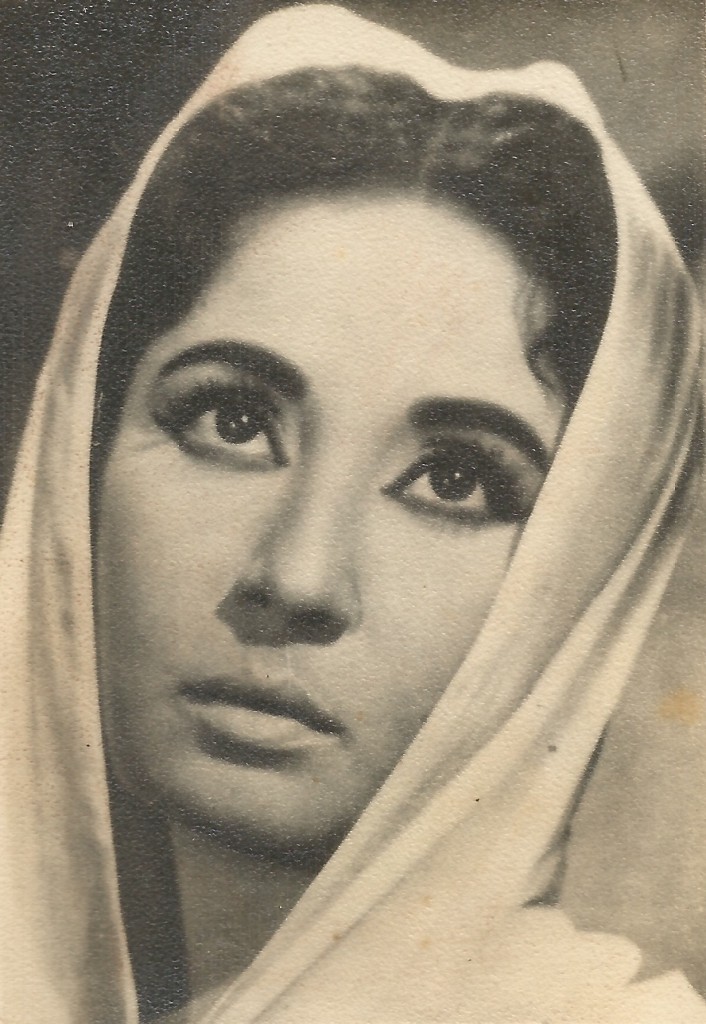
Meena Kumari was undoubtedly one of the greatest actresses in Hindi cinema. Few could match her in her dramatic roles as she gave the Indian film heroine much grace and dignity even in suffering. Acknowledged as the undispusted tragedy queen in Indian cinema, she did show that she could carry off lighter roles (Azaad (1955), Kohinoor (1960)) as well with equal ease.
She was born Mahjabeen Ali Bux (some sources say Mahjabeen Bano), the daughter of the Parsi theatre actor and music teacher, Ali Bux, and the dancer, Iqbal Begum, on August 1, 1932. Having hit upon hard times and living near Rooptara Studios, Ali Bux sought to get his daughters into films. And so Mahjabeen began her cinematic journey as a child actress. She was renamed Baby Meena and first cast in Vijay Bhatt’s Leatherface (1939). This led to other films where she played the child artist, the most prominent being Lal Haveli (1944) where she played the great Noor Jehan’s childhood avatar.
With Bachchon Ka Khel (1946), Baby Meena became a heroine – Meena Kumari. Her early adult work consisted of mainly mythological films like Veer Ghatotkach (1949), Shri Ganesh Mahima (1950), supporting roles in A-grade dramas Hamara Ghar (1950) and Sanam (1951) and fantasies like Alladin and The Wonderful Lamp (1952). All of these mostly B-films did nothing much for her till she hit the big time with Vijay Bhatt’s classic, Baiju Bawra (1952).
With Baiju Bawra, co-starring Bharat Bhushan in the titular role of Baiju who seeks to take revenge on the great Tansen for the death of his father by defeating him in a musical contest, Meena Kumari showed there was no one better than her to play the ideal, suffering and self-sacrificing Indian woman. The heroine in the film, Gauri, is ever ready to sacrifice herself for Baiju and is even willing to annihilate herself to provide him the experience of extreme heartfelt pain so that his music would be enriched! It was a strong, strong performance wherein she suffered with much dignity and it deservedly fetched her the inaugural Filmfare Award for Best Actress.
The same year (1952), Meena Kumari became filmmaker Kamal Amrohi’s second wife and with films like Daera (1953), Ek Hi Raasta (1956), Sharada (1957) and Dil Apna Aur Preet Parayi (1960), she went from strength to strength playing the masochistic suffering woman or the martyr to perfection thereby building up a strong reputation as ‘the queen of tragedy’. In Daera (1953), directed by Amrohi, her barren life and subsequent disintegration underscores the Indian woman’s lack of selfhood and remains one of the great moments of Indian screen acting. Kumari played a woman married to a much older man and who falls for a younger man (Nasir Khan). The film is Amrohi’s most elegaic and underrated film. While she convincingly played a young widow in BR Chopra’s Ek Hi Rasta (1956), in Sharada, she gave a tour de force performance as Raj Kapoor’s lover, who, by circumstances, becomes his step-mother. Unfortunately, coming in the same year as Mother India, Nargis swept all the acting awards that year but yet, the Bombay Film Journalists Association named Kumari as their best actress of the year for Sharada. In fact, many cine goers at the time thought Kumari’s nuanced rising-above-the-script performance in a rather melodramatic role was the superior act as Nargis, brilliant as she was in Mother India, had the advantage of a totally author-backed role.
Special mention must also be made of Kumari’s fine performance in Bimal Roy’s classic Parineeta (1953). She brings Sarat Chandra’s heroine, Lalita, beautifully alive on screen. She is coy yet firm, apparently timid, yet in command of herself when the situation so demands. Her strong conviction in the Hindu ritual of exchanging garlands as a sign of being married to the one the garland is exchanged with, even if this has been done as a light-hearted joke, underscores the strength of her character vis-a-vis Shekhar (Ashok Kumar), who is too weak to articulate his wish to marry her to his dictatorial father. Yet, she is prepared to surrender her love for what she feels is her rightful duty towards her uncle who brought her up when she was orphaned in childhood. The film would win Meena Kumari her second Filmfare Award for Best Actress.
It is a pity that Meena was known for her tragic roles and she too chose more such roles to cultivate her image of being the great tragedienne because in the few light-hearted films she did in between like Azaad, Mem Sahib (1956), Miss Mary (1957), and Kohinoor, she displayed an uninhibitedness that was refreshing to say the least. In these films, her physical movements are free and unrestrained and her dialogue delivery absolutely normal – a stark contrast to the studied mannerisms and passive postures of her tragic roles.
It was tragedy, however, which saw Meena Kumari’s greatest ever performance and immortalized her. The film was Sahib Bibi Aur Ghulam (1962). Produced by Guru Dutt, the film tells the story of Chhoti Bahu, the youngest bride in an aristocratic zamindar family who strives to make her errant husband return to her even at the risk of self-destruction. It is perhaps the greatest performance ever by an actress on the Indian Screen. The sequence where Chhoti Bahu dresses for her husband singing Piya Aiso Jiya Main is a poignant exploration of a woman’s expectations and sexual desire. You cannot help but be moved by her in the sequence where she pleads with her husband not to go to the kotha but to stay with her and then angrily turns on him to tell him how she has prostituted her basic values and morals and even turned to drinking alcohol just to please him.
That year Meena made history as she garnered all the three Best Actress nominations for the Filmfare Award – for Aarti (1962), Main Chup Rahungi (1962) and of course, Sahib Bibi Aur Ghulam for which she won the award. However, according to many, the common factors between the actress’s life and Chhoti Bahu are too dramatic to be merely coincidental – the estranged marital relationship, the taking of alcohol, turning towards younger male company, the craving to be understood and loved – all elements evident in Meena Kumari’s own life; elements which were mythicized in the film world in the 1960s. While on the professional front, the emphatic success of Dil Ek Mandir (1963), Kajal (1965) and Phool Aur Patthar (1966) kept her a top star, her marriage with Kamal Amrohi all but ended in 1964. She also got involved with upcoming actor Dharmendra, whose career she helped push, but after they broke up, her drinking got heavier and heavier. Her ‘tragic’ image grew in dimension by now she had manage to build up a successful image of the eternal martyr to whom life always gave a raw deal.
Meena spent the last years of her life playing mostly character roles albeit strong ones in potboilers like Jawab (1970) and Dushman (1971). She did come up with a strong portrayal of an old woman caught between two street gangs of frustrated, unemployed youth, whose accidental but senseless killing finally makes them realize the futility of violence in Gulzar’s directorial debut, Mere Apne (1971), and realizing she had limited time left to live, went out of her way to help ex-husband Kamal Amrohi complete what has now become a cult classic – Pakeezah (1972).
Pakeezah is a stylized, larger than life mythicization of the familiar tale of the prostitute with the heart of gold. Jointly planned by Meena and husband Amrohi in 1958, the film took 14 years to finally reach the silver screen. Filming had come to a halt when the couple split but Meena was now determined to complete it. There is grandeur in Amrohi’s filmmaking – an epic magnitude of treatment. The evocative songs and the background music create the right period mood and Amrohi’s eye for details brings great depth to the lavish sets. A deliriously lush romantic film, it is further elevated by a stunning performance by Meena in the dual roles of the mother and daughter. Pakeezah finally released in February 1972 and opened to just a lukewarm response but after her death on 31st March, 1972, the film went on to become a huge success at the box-office and has since then acquired legendary status and is today regarded as perhaps her best known film.
Meena Kumari’s last released film was Gomti Ke Kinare (1972), but sadly, the film flopped at the box-office.
Apart from her histrionics, Meena Kumari was also talented poetess in her own right, and she recorded a disc of her Urdu poems – I Write, I Recite – set to music by Khayyam. Tanha Chand, a collection of her poems under the pseudonym Naaz, was compiled by Gulzar and published after her death.