


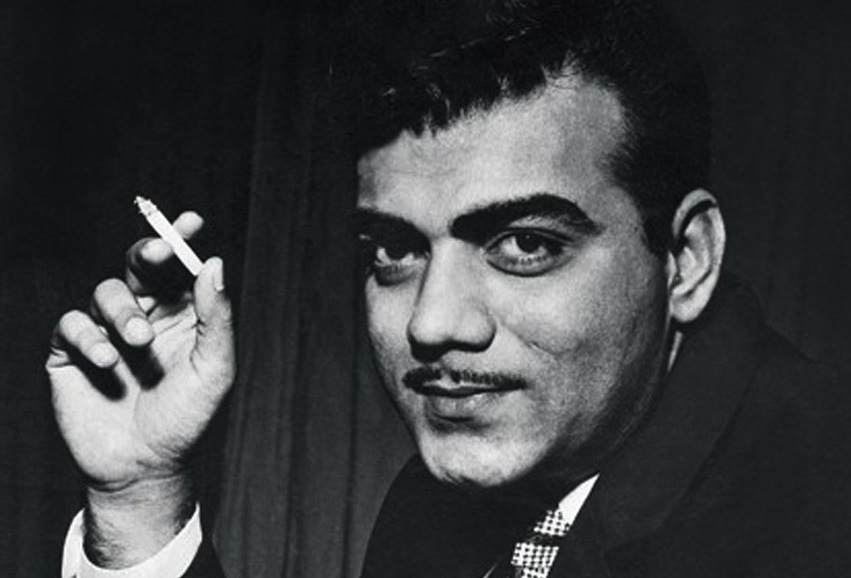
Such was Mehmood’s impact on the Hindi film scene that at the peak of his career in the late 1960s and early ’70s, leading heroes of Bollywood began refusing to work with him as they were afraid of being overshadowed. Perhaps there was some truth behind this – Gumnaam (1965), for all its fine ensemble cast, is primarily remembered for Mehmood’s comedy and his signature song – Hum Kaale Hain To Kya Hua Dilwale Hain; Pyar Kiye Jaa (1966) immediately has one thinking of Mehmood the wannabe filmmaker’s hilarious narration of his ‘film story’ to father Om Prakash; Humjoli (1970) instantly brings to mind Mehmood’s triple role – a take off on three generations of Indian cinema’s first family, the Kapoors. His mimicry of Prithviraj, Raj and Randhir Kapoor is superb and easily overshadowed the jumping jack antics of Jeteendra and Leena Chandavarkar, the lead pair.
Born on September 29, 1932, the son of comedian Mumtaz Ali, a film and stage actor-cum-dancer, and brother of dancer actress Minoo Mumtaz, Mehmood was a born comic. His mother once caught him at a railway station, attempting to run away from home, when he was still a child. When she angrily reminded him that even his clothes had been bought by his father, Mehmood quickly began to drop his clothes at the station itself!
Mehmood began earning money from an early age by doing odd jobs. He sold poultry products, drove a car for PL Santoshi and even taught table tennis to Meena Kumari. After he married Meena Kumari’s sister Madhu and had a son, Masood, in the early 1950s, Mehmood felt a pressing need to take proper care of his family. He accepted small roles in films. Today, one recognises Mehmood in tiny roles in films like Do Bigha Zamin (1953), CID (1956) and Pyaasa (1957), but sadly for him, he largely went unnoticed. Besides, his self respect did not allow him to let Meena Kumari help him either. In fact, he walked out of a Meena Kumari starrer Ek Hi Raasta (1956) because he was offered the role due to his being her brother-in-law! Incidentally, as a child he played the childhood version of Ashok Kumar in Bombay Talkies’ smash hit, Kismet (1943)!
It was finally with Parvarish (1958) with Raj Kapoor and Mala Sinha in the lead where Mehmood was first noticed in a big way. The success of Chhoti Bahen the following year led to a series of films with Shubha Khote, herself a fine comedienne – Sasural (1961), Ziddi (1964), Love in Tokyo (1966) among others. To quote her “We struck up a fantastic rapport. No one had to tell us; we knew what would come from the other person.” Dhoomal often played the third part of this triangle, generally as Khote’s father, who always opposed their romance but had to give in by the end. By now, songs were an integral part of Mehmood’s roles and it has to be said he excelled in them. In films like Kaagaz Ke Phool (1959) or Howrah Bridge (1958), he was present in the film for just a single song that was filmed on him with other artists.
Dil Tera Deewana (1962) starring Shammi Kapoor and Mala Sinha firmly made him a top star. Thereafter, he took over from Johnny Walker as the leading comedian of Bollywood. Practically every well known film of the 60s had a parallel comic track with Mehmood – Arzoo(1965), Patthar ke Sanam (1967), Padosan (1968) etc. In fact, when Filmfare added on the award for best performance in a comic role – Mehmood was the first winner for his outstanding work in Pyar Kiye Jaa. As mentioned his scene with Om Prakash is the highlight of the film! The way he narrates the film with the use of sound effects to heighten the story has to be seen to be believed. It is Mehmood at his outrageous best! He went on to win the Filmfare award twice more for Waaris (1969) and Vardaan (1974).
True, there were some who thought Mehmood to be loud and bawdy but he struck a chord with audiences and knew exactly how to tickle their funny bone! Mehmood was a master at playing the hero’s friend, who would help him out of sticky situations with his street-smart ways. He often had funny songs – Thenge se in Patthar ke Sanam (1967) or Aiyayo Aiyayo from Pyar Kiye Jaa or weird vocabulary – words like Wua Wua or Kudu Kudu to supplement his antics! Many of his songs were sung by Manna Dey. And apart from Shubha Khote, he also made a great team with fellow comedian, IS Johar, and actress, Aroona Irani. Mehmood also successfully reworked a lot of Tamil comedian’s Nagesh’s roles for himself in Hindi. For instance, Main Sundar Hoon (1971), Bombay to Goa (1972) and Do Phool (1973) were inspired from Server Sundaram (1964), Madras to Pondicherry (1966) and Anubavi Raha Anubavi (1967) respectively.
In the 70s Mehmood increasingly turned to making films for himself. In trying to show his range as an actor, these films were an uncomfortable mix of over-the-top melodrama and emotion and comes and not entirely successful.
He then retired to his farmhouse in Bangalore just doing the odd film now and then. But even today actors like Rajpal Yadav admit the influence of Mehmood in their work. To quote him, “He was an institution for us actors, who have learnt so much just by watching his films. I have been very unfortunate as I have never met him. Being a comedian, I know the contribution he has made to people like us.”
Acting aside, it was Mehmood who gave RD Burman his first break with Chhote Nawab (1961)and worked with him regularly down the years until a misunderstanding with Burman in the 70s saw him introduce Rajesh Roshan with Kunwara Baap (1974). He is also responsible in a way for Amitabh Bachchan’s rise to fame as it is after seeing him in Mehmood’s Bombay to Goa (1972), Salim-Javed found in him the perfect angry young man for their stories!
Mehmood passed away after a prolonged illness in the United States on July 23rd, 2004.