


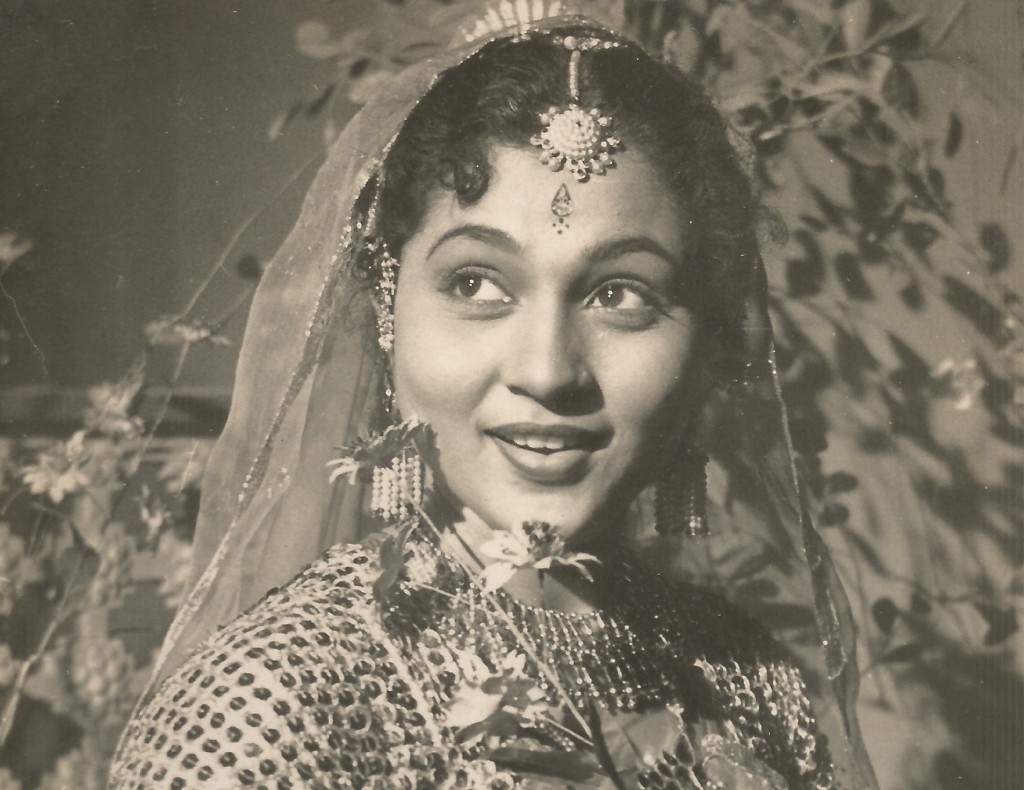
To most Indian filmgoers, Nirupa Roy was – to put it simply – the mother of all mothers. And to a large extent, this is more than true. No other actress except perhaps Leela Chitnis epitomized the suffering Indian screen mother more than Nirupa Roy but it is important to note that Roy also made a mark as the leading lady of many a mythological film (She must have played every Devi and every Sati in Indian mythology), various costume dramas (Amar Singh Rathod (1956), Rani Roopmati (1959), Razia Sultana (1961)) and several realistic dramas as well. (Do Bigha Zamin (1953), Pehli Tareekh (1954) and Garam Coat (1955)).
Nirupa Roy was born Kokila Kishorechandra Balsara in Valsad, Gujarat on January 4, 1931. She made her film debut in 1946 with the successful Gujarati feature film Ranakdevi, a legendary folk legend of Gujarat. However it was with Ranjit Movietone’s Gunsundari (1948) that she became a star. This was the third version of the film following Chandulal Shah’s versions in 1927 and 1934. Along with Ranakdevi, this film effectively founded the Gujarati film industry and was a triumph for Roy playing the sacrificing wife who wins back her husband from another woman.
Har Har Mahadev (1950) was one of Roy’s best known mythological. She played Parvati in this film directed by Jayant Desai. The film was a major success and is still remembered for its music score by Avinash Vyas particularly Gun Gun Gun Gunjan Karta Bhawara and Kankar Kankar se Main Poonchoon rendered by Geeta Dutt. The film led to a long running career in mythological films and costume dramas opposite actors like Trilok Kapoor, Manhar Desai, Jairaj and Mahipal through the 1950s with occasional better tear jerking roles opposite heroes like Ashok Kumar (Bhai Bhai (1956), Bedard Zamana Kya Jaane (1959)) and Bharat Bhushan. Her pairing with the latter, particularly Rani Roopmati, is remembered till today especially the song Aa Lautke Aaja Mere Meet. The two also acted together in Kavi Kalidas and Samrat Changragupt.
https://www.youtube.com/watch?v=A2an4z4D3V0
The other genre of films that saw Nirupa Roy make a strong impact was the ‘realistic’ films. Following her strong turn as the peasant wife opposite Balraj Sahni in Bimal Roy’s Do Bigha Zamin, she went on to do more films with Sahani like Garam Coat and Tonga-Wali (1955). Munimjee (1955) saw Roy make her first mark as the mother of the hero. This, when she was 8 years younger than the hero, Dev Anand. Such was her impact however that she won the Filmfare Award for Best Supporting Actress that year. She won the award again for Chhaya (1961) playing… a mother! The same year saw another strong performance from Roy as a foster mother in Yash Chopra’s Dharamputra (1961) where she played a Hindu woman who brings up an illegitimate Muslim child.
While she was busy enough through the 1960s and early 70s, her career defining moment however came in 1975 with Deewaar where she played the mother to Amitabh Bachchan and Shashi Kapoor. The mother was the pivotal character of this film and director Yash Chopra even tried unsuccessfully to get Vyjayanthimala to make a comeback. Deewaar is a prime example of the importance of the mother syndrome in Indian Cinema. The mother had grown from a minor character in early Indian Cinema to occupy centre stage as epitomized in Mother India (1957). The highlight of the film is an exchange between the two estranged brothers who now live separately. Bachchan tells Sashi Kapoor that what has Kapoor got in life being an honest cop – a job, a uniform a Government quarter and look at him (Bachchan). He has amassed much wealth, property. He has everything. What does Kapoor have? Kapoor retorts he has their mother! Bachchan has no answer to this!
https://www.youtube.com/watch?v=bydPnnvXLpY
Till today the mother figure is an extremely crucial factor to mainstream Indian Cinema. She is still deified and what is most interesting is that she always has an obsessive relationship with her son(s) but hardly ever with her daughter(s)! Nirupa Roy lives her role as the long-suffering mother making it her own, which established her as the leading screen mother of Hindi Cinema of the 1970s and 1980s particularly as Bachchan’s mother – Amar Akbar Anthony (1977), Muqaddar ka Sikander (1978), Suhaag (1979), Mard (1985) to name some of their important films. However, Hindi films thrive on stereotypes and practically all the mother roles she played were the same. She would usually play the mother as a victim in order for the hero to engage in revenge to restore family honour.
Gradually by the mid 1980s, she began cutting down on her work and settled into retirement. She did come back in 1999 once more to play… what else, the mother to… who else, but Bachchan in Lal Badshah.
Nirupa Roy became one with the several goddesses she played when she passed away on October 13, 2004 in Mumbai due to a heart-attack.